
European water frogs from Pelophylax esculentus complex are an example of natural interspecies hybridization and polyploidization. Diploid and triploid hybrids Pelophylax esculentus (Linnaeus, 1758) can reproduce through crossing with parental species due to the phenomenon of hemiclonal inheritance. Siverskyi Donets center of diversity of water frogs (east of Ukraine) is characterized by various population systems, where hybrids (both di- and triploid) live and reproduce with only one parental species P. ridibundus (Pallas, 1771) (the other parental species P. lessonae (Camerano, 1882) is absent). In 2018 it was found that population system in floodplain lake (village Brusivka, Donetsk region) [1] consists of P. ridibundus individuals of both sexes and only of female triploid hybrids P. esculentus (R-Epf type). Such type of population system was first described by G. Lada in 2010 in lake Pidpesochne (Kreminna, Lugansk region) [1].
Previous research on reproduction of triploid hybrids showed that they appear due to diploid gametes (both male and female) produced by diploid hybrids [2]. In Brusivka neither male nor diploid hybrids were found. Therefore, we can distinguish two main problems: (i) the way of triploid appearance; (ii) absence of male hybrids.
In this study we focused on the second problem. We suggested three hypotheses: (i) genetically male individuals develop as females; (ii) male tadpoles eliminate on early stages of development (gonads are not differentiated); (iii) male tadpoles eliminate on late stages of development during metamorphosis or later (gonads are formed).
To check, which hypothesis is right, we studied 18 tadpoles produced by crossing between triploid P. esculentus female and P. ridibundus male collected in Brusivka. We got tadpoles from D. A. Shabanov, who had provided crossing. We identified tadpoles' stages of development according to Gösner [3], and then incubated tadpoles in 0.4% colchicine for 12-18 hours. After anesthesia, sex was identified by gonad morphology [4]. The ploidy of individuals was determined by Ag-staining with addition of Giemsa-staining [5]. We estimated number of metaphase chromosomes and interphase nucleoli in cells of intestine epithelium.
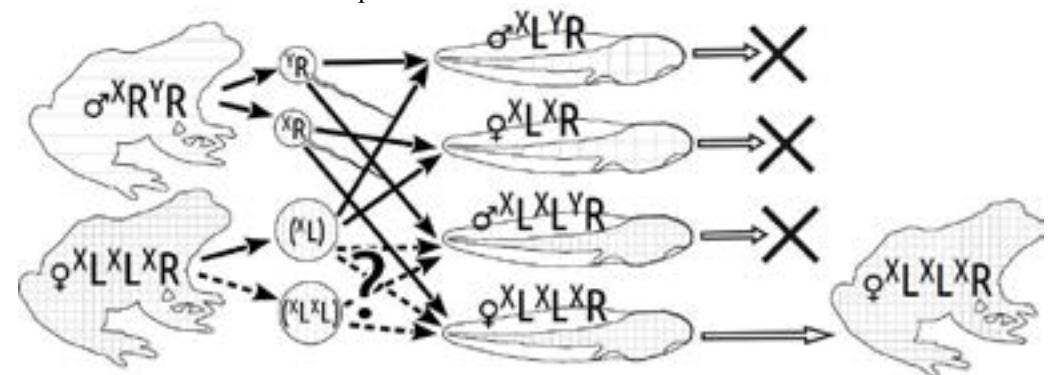
Our previous data shows that female have genotype composition LLR (2 genomes of P. lessonae and 1 genome of P. ridibundus) and can produce haploid gametes with L-genome (probably, reduplication takes place after fertilization) [1]. Based on the data of system composition we can assume that only triploid females can occur in artificial crossing. However, we found both triploid males (4 from 18 tadpoles) and diploid individuals (3 males and 7 females) (Fig. 1.). The presence of triploid males on late stage of development (from 28 and more) supports our third hypothesis (elimination takes place during metamorphosis or later). Presence of diploid individuals can be explained in 2 ways: (i) reduplication of L genome doesn't always happen; (ii) triploid females produce mix of L and R gametes. The latter is unlikely, because production of R-gametes by LLR females from various systems was never shown.
Our next steps are to repeat artificial crossings and analyze more quantity of progeny after metamorphosis, and to provide taxonomic identification of diploid and tadpoles.