
Carbacylamidophosphates (CAPh) – compounds containing the functional fragment -C(O)N(H)P(O)= belong to the broad class of the powerful ampolydentate ligands. Due to the presence of phosphoryl group in the composition of CAPh ligands they have high affinity for the majority of metal ions. The possibility to be involved in the coordination sphere both in molecular and acidic forms, makes the coordination chemistry of these ligands extremely diverse and interesting [1].
On the basis of one representative of CAPh ligands - N, N'-dibenzyl-N "- trichloroacetylphosphortriamide (HL), di- and tetrameric complexes of the composition Co2L4(CH3OH)2 and Cu4L4(OCH3)4 were synthesized and obtained in the crystalline state. Obtained compounds were investigated by means of IR spectroscopy, thermogravimetric, magnentochemical and X-ray diffraction analysis.
The bidentate-cyclic coordination of CAPh ligand through oxygen atoms of the phosphoryl and carbonyl groups was established for both complexes under consideration.
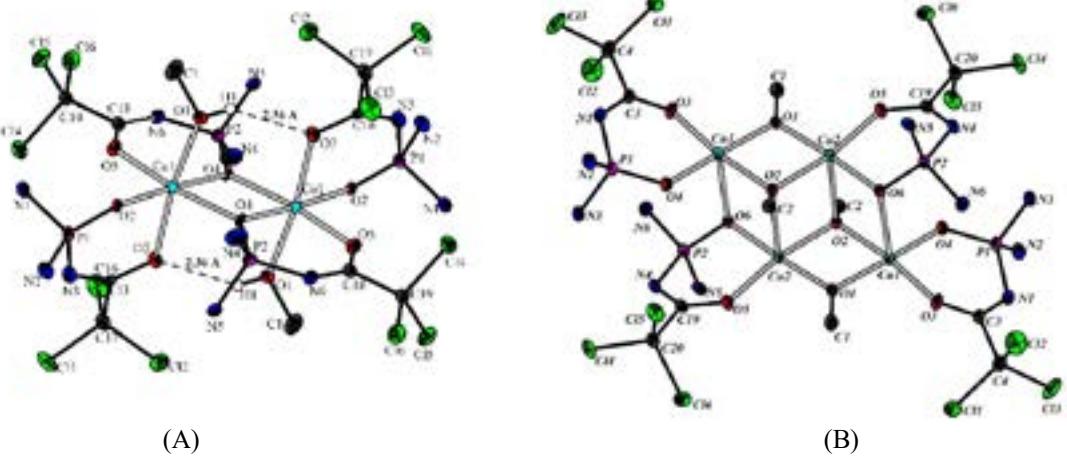
In the Co2L4(CH3OH)2 structure cobalt ions are connected in the centrosymmetric dimers due to the bridging function of the phosphoryl groups (Fig. 1). The coordination sphere of each cobalt ions includes also methanol molecule, coordinated by oxygen atom and additionally linked to the carbonyl group by hydrogen bond. Last one can be considered as an additional stabilizing factor in the formation of the dimeric structure.
Complex Cu4L4(OCH3)4 contents methylate ions which due to μ3-bridging function connect four copper ions in the tetramer (Fig. 1). According to results of thermogravimetric investigations, the first mass loss for the cobalt complex corresponds to missing of two methanol molecules (the range temperature from 80°C to 150°C). This process combines with the process of oxidative degradation of organic ligands.
Unlike the compound of cobalt, the tetrameric copper complex contains methylate ions, therefore it is resistant to the temperature of 110°C. Further rising of temperature leads to the destruction of the organic part of copper complex.