In 1964 M. Gell-Mann and G. Zweig offered an idea [1] that hadrons are made of more elementary constituents, called quarks. Later it was found that hadrons are actually made of sea quarks and valence-quarks, which are held by gluons. Although quarks have a charge, they cannot be simply measured as electrons, due to their confinement in hadrons. This does not mean that they cannot be observed using experiments.
Quark-antiquark annihilation can be observed indirectly during high energy hadron collisions. Quark pair annihilation may produce a virtual Z boson, which decays into a lepton-antilepton pair. The Drell-Yan [2] process is a mechanism when quark-antiquark annihilates and lepton-antilepton is produced. This process can be observed experimentally and provides useful information about parton distribution functions, which describe the inner structure of hadrons. The Compact Muon Solenoid (CMS) [3] is one of the big CERN LHC particle accelerator detectors. The CMS detector is made of several layers. Each layer is designed to stop, track or measure different particles obtained from proton-proton or heavy ions collisions. Since most of the produced particles are unstable, they rapidly transform into the stable ones, which can be detected by the CMS. Some of the registered data can be publicly obtained from the OpenData [4] portal. The portal also provides a software and instructions of how to use data. Data analysis is done using CMS software, which is pre-installed in the CMS Virtual Machine (VM). Before starting the analysis it is useful to get acquainted with the CMS VM environment and example exercises. Therefore, a CMS Virtual Machine configuration manual [5] in the Lithuanian language was created.
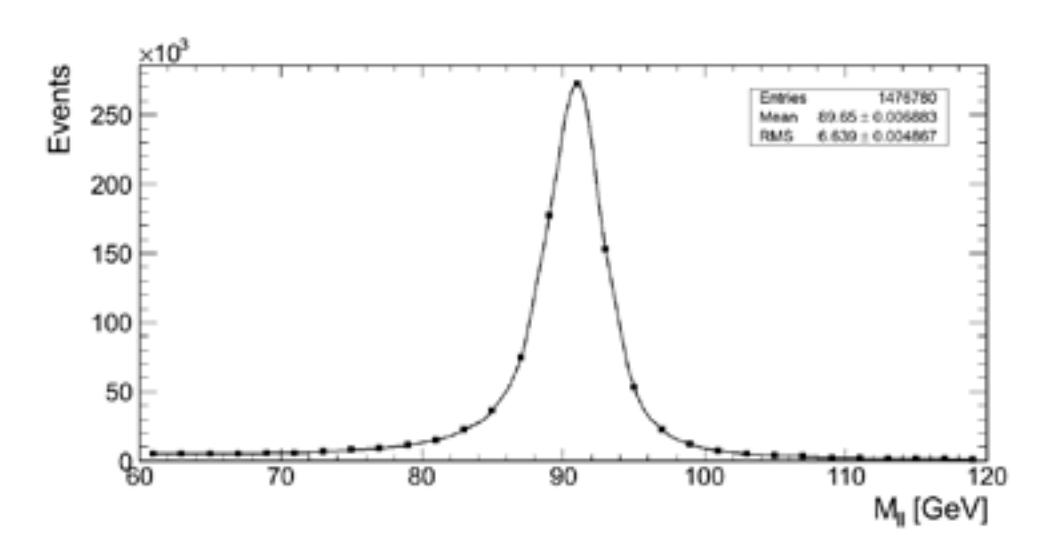
This contribution presents results of the CMS 2011 collisions at $\sqrt{s} = 7$ TeV data analysis, that show a properly configured and working CMS VM. Results were obtained by modifying the example exercise to search for a process where the Z boson decays into a muon-antimuon pair. Fig. 1 shows a Z candidate invariant mass distribution, obtained analyzing data sets in CMS VM. Histogram's mean value within the error matches the known Z boson mass –91.19 GeV. Also, the histograms of energy, transverse momentum, and momentum components were obtained.