
Luminescence – light emitting process when electron jumps from excited to a ground state. In order to observe this process within transparent medium a very strong electromagnetic field is required. Such intensities could be reached during experiments as cathodoluminescence, X-ray luminescence, photoluminescence, etc. In this work we are offering to use filaments of light in order to investigate luminescence spectrum and associated decay of excited states. This method is more convenient compared to cathodoluminescence or X-ray luminescence because specimen is excited by laser beam. In this way, we have system which is easily adjustable and has cheap, simple optics. Use of filaments in luminescence spectroscopy is a nondestructive way to examine transparent solid material in order to determine laser media quality.
Filament occurs when femtosecond laser pulses are focused onto transparent medium and generates wide spectrum coherent radiation – white light continuum. When light self-action occurs laser beam shrinks to micro-meter size and pulse spectrum spreads over several octaves. Filament excites impurities and charge carriers within medium. In this experiment luminescence is observed and registered from the side of the filament. In order to compare the optical quality of popular laser media crystals such as YAG, Al2O3 and KGW, provided by different manufacturers spectra and luminescence decay characteristics were measured. By analyzing spectrum induced by light filament, it was possible to identify undesirable impurities and their amount in crystals. Luminescence decay measurements exposes the lifetime of states and reveals correlation between them.
In conclusion, filament luminescence is suitable way for medium quality investigation because different manufacturer specimens create specific luminescence spectra, varying in distribution of intensity and characteristic peaks.
Spectrum of YAG crystals reveals that intensive luminescence could be generated by lattice defects and transition metals. The spectra reveal a trace amount of Chromium ions. Non-homogeneous decay in short wavelength range was observed, possibly due to higher energy electron transition to lower energy states, within the band.
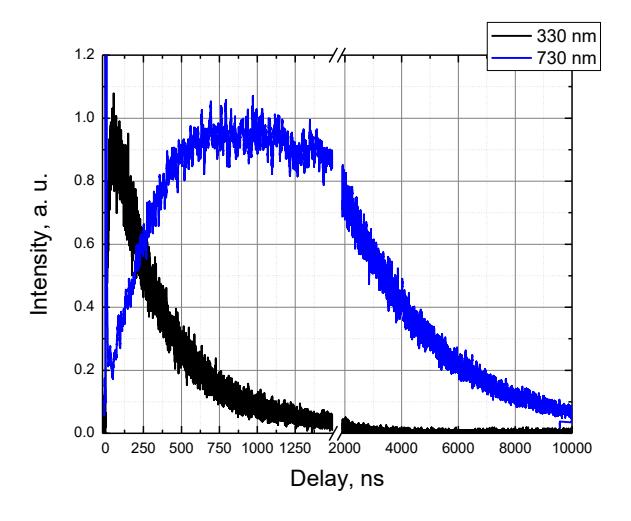
Luminescence in Sapphire could be generated by $F^+$ center defects and transition metal ions. The decay of the peak in UV region is correlated to peak in IR, which could indicate a transition between two distinct energy states (Fig. 1).
Luminescence peaks in KGW crystals could be created by rare earth and transition metal ions. KGW spectra hints that there is Europium and Terbium ions. The associated decay reveals that these ions creates long-lasting phosphorescence states, with possible impact on high repetition rate applications.