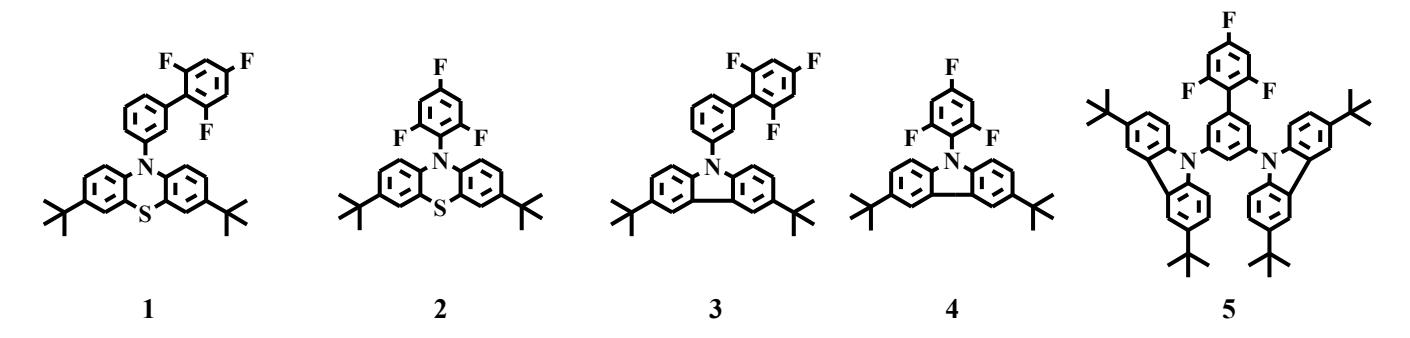
Electroactive organic compounds are used as light-emitting materials for optoelectronic devices such as light-emitting diodes, solar cells and electrophotographic photoreceptors [1, 2]. Phenothiazine and carbazole-based compounds have advantageous characteristics such as thermal and electrochemical stability, high electron/hole conductivity and efficient luminescence [3, 4]. Due to these properties phenothiazine and carbazole fragments were chosen for this study. The synthesis and properties of phenothiazine and carbazole derivatives bearing trifluorophenyl-acceptor group 1-5 are presented (Fig 1). The materials 1-5 were synthesized by Ullman-coupling and Suzuki-coupling methods.
Fig. 1. Structures of 1-5.
The structures of the synthesized compounds were proved by 1H and 13C NMR spectroscopy and mass spectrometry.
The behavior on heating of compounds 1-5 was studied by differential scanning calorimetry (DSC) and thermogravimetric analysis (TGA) under a nitrogen atmosphere. A temperature ranging from 201°C to 369 °C of compounds 1-5. Compound 5 demonstrates the highest thermal stability (369 °C).
The ionization potentials of the derivatives were estimated by cyclic voltammetry (CV). They were found to be comparable and ranged from 4.85-5.25 eV. The electron photoemission spectra of layers of the derivatives showed the ionization potentials of 5.84-6.19 eV.
The fluorescence emission wavelength of compounds is in the region of green-blue light. Triplet energy values ranging from 2.58 eV to 2.88 eV were determined from phosphorescence spectra. Because of that the materials can be used as matrix for blue emitters [5].
Acknowledgments: This research was funded by the European Social Fund under the No 09.3.3-LMT-K-712 "Development of Competences of Scientists, other Researchers and Students through Practical Research Activities" measure.
[1] Forrest, S. R.; Thompson, M. E. Eds. Organic Electronics and Optoelectronics. Chem. Rev.2007, 107, 923-1386.
[2] Shirota, Y.; Kageyama, H. Charge Carrier Transporting Molecular Materials and Their Applications in Devices. Chem. Rev.2007, 107, 953-1010.
[3] Gruzdeva M. S.; Chervonovaa U. V.; Venediktova E. A.; Rozhkovaa E. P.; Kolkera A. M.; Mazaevb E. A.; Dudinaa N. A. and Domrachevac N. E. Synthesis and Photochemical Properties of 3,6-Di-tert-butyl-9H-carbazole Derivatives. Russian Journal of General Chemistry, 2015, Vol. 85, No. 6, pp. 1431–1439.
[4] Jen-Hsien Huang and Kuen-Chan Lee. Highly Stable, Solution-Processable Phenothiazine Derivative as Hole Collection Material for Organic Solar Cells. ACS Applied Materials & Interfaces20146 (10), 7680-7685.
[5] G. Grybauskaite-Kaminskiene, D. Volyniuk, V. Mimaite, O. Bezvikonnyi, A. Bucinskas, G. Bagdziunas, J.V. Grazulevicius. Aggregation-Enhanced Emission and Thermally Activated Delayed Fluorescence of Derivatives of 9-Phenyl-9H -Carbazole: Effects of Methoxy and tert-Butyl Substituents. Chem. Eur. J., 2018, 24, 9581-9591.