
Constantly expanding the biofuel boiler network in Lithuania there are large amounts of ash from this fuel that are not rationally used and accumulate as waste. Biofuel ash is alkaline waste ($pH \sim 13$) [1]. It is therefore very useful to use it where there are acidic soils ($pH < 5.5$). In ash contains a lot of nutrients (K, P, Ca, Mg), which are necessary for plants and soil.
Biofuel ash can be practiced by as agriculture fertilizer. The environment benefits when less waste ends up in landfill sites and nutrients are returned to the environment from which they came.
The objective of the present study was to produce granulated biofuel ashes. To investigate chemical composition, structure of granulated, strengths, to assess their quality and the impact the soil. For the experiment, we used three different ash variants of granulated biofuel, where the ash content in the granule was 30 %, 50 % and 70 %. The concentrations of heavy metals (Cd, Cr, Cu, Pb, Ni, and Zn) in the granules were sufficiently low not to prevent their use in agriculture fertilizer [2]. Overall, the concentrations of nutrients (Ca, Mg, K, and P) were reasonably high [3].
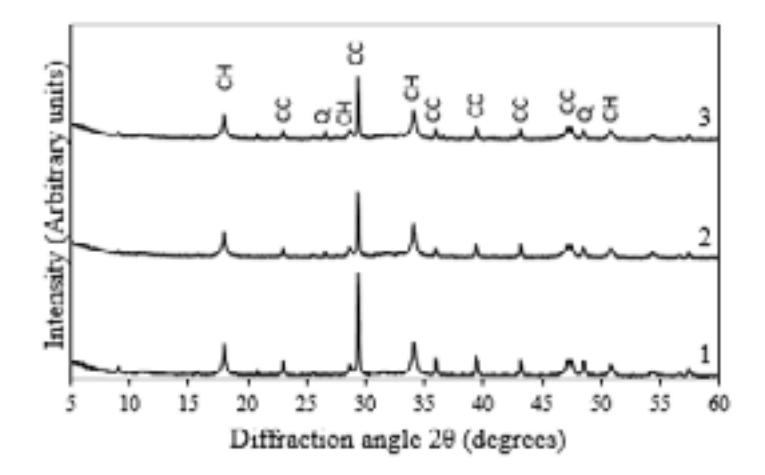
The XRD patterns attributed to calcium hidroxide, calcium carbonate and quartz were identified in all granulated biofuel ash samples. The main difference between the samples was the intensity of the calcium carbonate peaks, which decreased with increasing granule size (Fig. 1). Biofuel ash is generally used for fertilization because of its very long-lasting fertilizing effect. The granules should be hard enough to promote gradual and slow dissolution of nutrients to the forest soil during several years. On the other hand, too high compressive strength may also be problematic since it can retard and possibly prevent the leaching of nutrients [3]. Pellet strength increases as the ash content of the pellet increases.
Fertilization was carried out two weeks before sowing. During vegetation, the consumption of minerals was recorded, which confirmed that the growth of spring barley absorbed most of the nutrients from the soil. Meanwhile, the loss of material was reduced to the end of vegetation, and therefore the concentration of minerals increased again. After measuring the concentrations of Cd, Cr, Cu, Pb, Ni, and Zn, it became clear that the soil was not contaminated with heavy metals, proving that these materials did not damage plant vegetation.