X-Rays generation with ultrashort, high energy laser pulses is an attractive technique in ultrafast technology field. X-Ray emission obtained with this technique showcase unique characteristics [1] and could be used for numerous industrial, medicine and material science applications. Brilliance of X-rays generated by femtosecond laser pulses is comparable to that of synchrotrons, but a laser system is cheaper and more compact than a synchrotron.
One of the main goals of this study is to achieve a high emission yield and spectral light emittance at average X-Rays range (1 keV–20 keV). Previous experiment with metal targets in this area has shown that the X-Ray emission yield in the energy range mentioned before, is not sufficient [2].
For this experiment as targets we chose alkali metal halide salts — NaCl, KBr, KI, CsI. These compounds have a big energy band gap and are transparent in a wide range. Thus Plasma could be generated in the volume of the target rather then on the surface. This allows us to expect for better X-Ray emission yield than that of metal targets. More complex and non traditional laser beam geometries could be applied because of the target transperancy. "Pharos" femtosecond laser system (Light Conversion Ltd., central wavelength $\lambda$=1028 nm, pulse energy Ep = 90 μJ – 1500 μJ, pulse duration $\tau$p = 190 fs, average output power 6 W, pulse repetition rate was changed from 1 kHz to 10 kHz) was used for X-Ray excitation in the targets. For detection of X-Rays "Amptek X-123" detector was used, positioned at 45° angle prior to the target ant the laser beam.
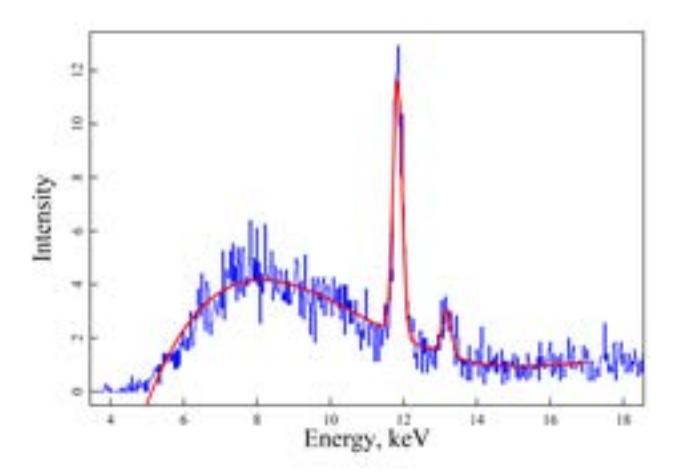
The plasma X-Ray source was generated in the KBr target, as seen in the Fig. 1. There are clearly distinguishable bromide Kα and Kβ X-Ray lines at 11.92 keV and 13.29 keV respectively as identified by NIST database [3].