
It is known that heterogeneous flows affect the ablation of heat-shielding materials which strongly depends on the parameters of the dispersed phase. This is especially relevant when assessing the performance of thermal protection of rocket and space technology products both when landing descent objects on other planets, such as Mars, and when flying in the Earth's atmosphere [1]. In this regard, one of the main issues is the experimental study of the ablation of heat-shielding materials in conditions close to real. To do this, it is necessary to create heterogeneous high-temperature flows specified by thermal and aerodynamic parameters and careful control of parameters such as heat flow, deceleration pressure, velocity of gas flow and dispersed phase (particles), their size, temperature, etc.
The aim of the work is an experimental study of the interaction of a two-phase plasma flow with heat-shielding materials: fluoroplast, textolite, asbestos-textolite. We used a high enthalpy two-phase flow formed by an electric arc gas heater of a linear scheme with gas-dynamic and magnetic stabilization of an arc discharge, which makes it possible to obtain thermal and velocity flows comparable to real in laboratory conditions. As the dispersed phase, SiO2 powder with a particle size of not more than 50 μm was used. The heat flux in various sections of the plasma jet was measured using uncooled regular mode sensors with an accuracy of ± 10%. Copper calorimeters of tablet type were used as heat-receiving elements, in which the temperature of the protected end was measured with a chromel-copel thermocouple. The velocity of the dispersed phase in the plasma flow was measured by the Particle Image Velocimetry (PIV) method, which allows to record 'instant' spatial velocity distributions. The scheme of the experiment is shown on Fig.1.
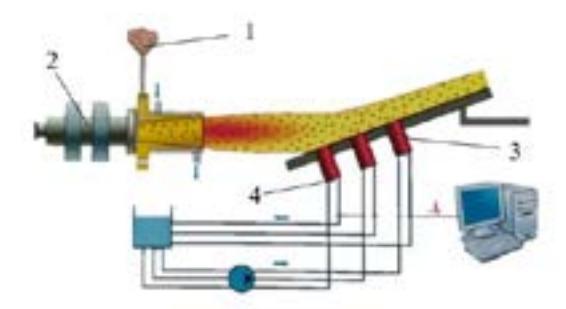
During the experiment, for a steady subsonic mode of operation of an electric arc gas heater, the magnitude of the heat flux was obtained in different sections of the plasma homogeneous jet. The value of the heat flux on the axis of the plasma jet near its end is 200 W/cm2 and monotonously decreases to 20 W/cm2 at 280 mm. It is shown that the obtained value of the linear rate of destruction along the sample axis for all materials increases significantly with the introduction of dispersed SiO2 particles into the homogeneous flow.
The results obtained can be used in solving practical problems related to the simulation of the phase of the entrance of a spacecraft into the atmosphere and the creation of advanced thermal insulation materials.