
Phosphorescent organic light emitting diodes (PhOLEDs) have drawn much attention because they use both singlet and triplet excitons for the emission of light and 100% internal quantum efficiency is possible in this case. The high internal quantum efficiency depends on several factors such as high quantum yield emitters, exothermic energy transfer from host to emitter, effective exciton confinement as well as balanced carrier transport [1, 2]. It is well demonstrated that carrier transporting materials are very important to enable a balanced carrier transport from cathode and anode [3, 4].
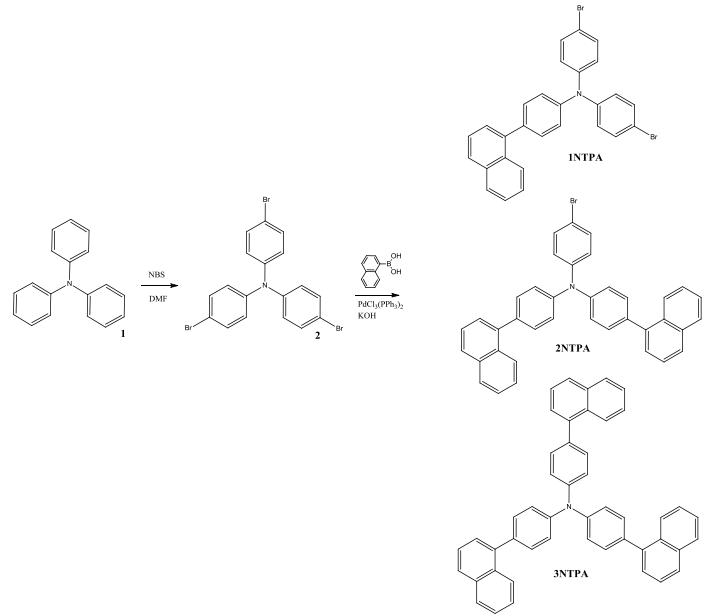
The synthesis of naphthyl substituted triphenylamine compounds (1NTPA-3NTPA) was carried out by two step synthetic route as shown in Scheme 1. Tris(4-bromophenyl)amine (2) as a key material was obtained by bromination reaction of triphenylamine (1) with N-bromosuccinimide in DMF. 1-Naphthyl substituted derivatives 1NTPA-3NTPA were obtained by the Suzuki reaction of the tris(4-bromophenyl)amine (2) with 1-naphthalene boronic acid.
Naphthyl substituted triphenylamine and its derivatives with bromine atoms were synthesized and investigated. The respective glass transition temperatures of the materials were estimated to be in a range 65-137 °C, which can provide morphologically-stable amorphous films for applications in organic light emitting diodes. The compounds possess adequate ionization potentials (5.5-5.75 eV), high hole drift mobilities (>10-3 cm2/ V·s) and suitable triplet energies (~ 2.4 eV), which make them suitable hole transporting materials for use in red phosphorescent organic light-emitting diodes. A superior peak efficiency of 17.9% (31.4 cd/A and 26.9 lm/W) was achieved in a device having hole transporting layer of tris[4-(1-naphthyl)phenyl]amine. Furthermore, the device gave efficiencies of 17.7% and 16.6% recorded at luminance levels of 102 and 103 cd/m2. The efficiency drop from the maximum to the value recorded at the luminance of 103 cd/m2 for the device was only 7%.