The electrochemical synthesis of electrically conducting organic polymers has proven important in allowing development of new polymeric materials with electrochemical and/or electrical properties [1]. According to this approach, semiconducting polymers have been obtained from a wide variety of monomers which include thiophene [2], aniline [3], carbazole [4] and etc. For the discovery and study of conducting polymers, the chemistry Nobel Prize in 2000 was awarded These conducting polymers have received much attention in both fundamental and practical studies because they have electrical and electrochemical properties similar to those of both traditional semiconductors and metals. Moreover, these polymers have been successfully used in biosensors as conducting mediator between enzyme and electrode [1,4], LED lighting and electrical supercapacitors and in other applications [5].
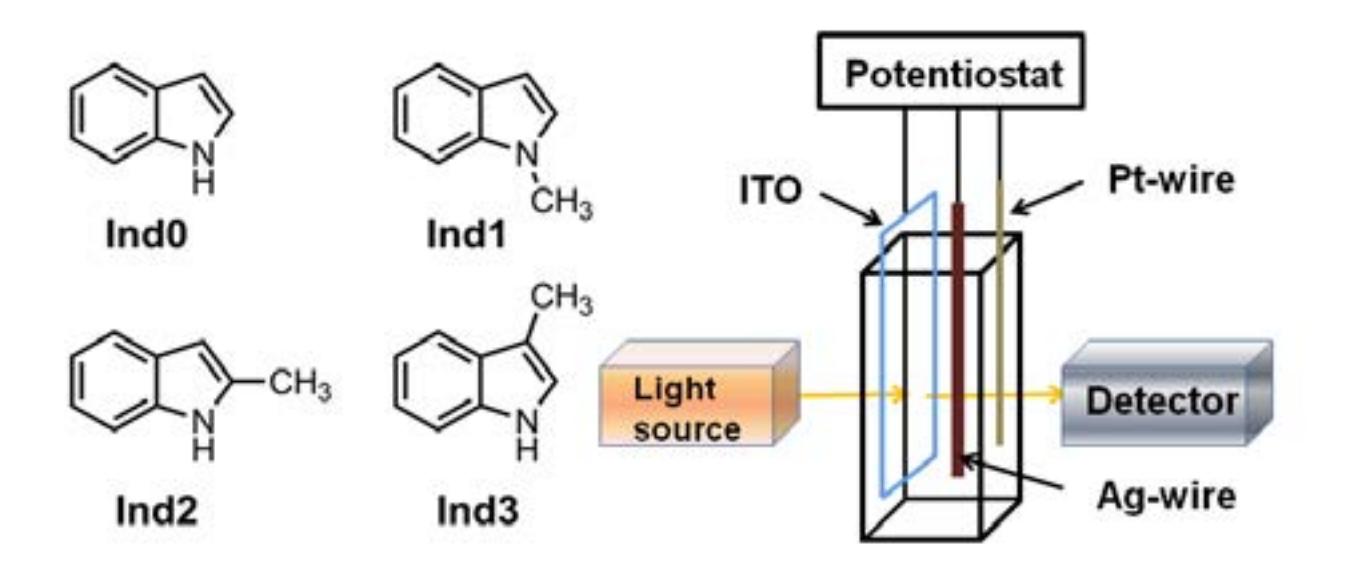
Fig. 1. Structures of the starting methyl substituted indole derivatives and schematic view of the electrochemical cell for the electrochemical investigations.
In this work, substituent effects in the electropolymerization of the methyl substituted indole derivatives on a transparent indium tin oxide (ITO) electrode were investigated (Fig. 1). These prepared polymers were studied by using the cyclo voltamperometry (CV), Raman spectrometry, scanning electron microscopy (SEM) methods. Moreover, for a study of electrochromic properties, most stable conducting polymer based on a nonsubstituted indole was used and evaluated. We hope that this work will be useful for further research of conductive polymers.
Acknowledgments: Financial support from the Research Council of Lithuania a grant No. 09.3.3-LMT-K-712-02-0186 is gratefully acknowledged.
[1] Nezakati, T.; Seifalian, A.; Tan, A.; Seifalian, A. M. Conductive Polymers: Opportunities and Challenges in Biomedical Applications. Chem. Rev.2018, 118 (14), 6766-6843.
[2] Gicevicius, M.; Bagdziunas, G.; Abduloglu, Y.; Ramanaviciene, A.; Gumusay, O.; Ak, M.; Soganci, T.; Ramanavicius, A. Experimental and Theoretical Investigations of an Electrochromic Azobenzene and 3,4-Ethylenedioxythiophene-Based Electrochemically Formed Polymeric Semiconductor. ChemPhysChem2018, 19 (20), 2735-2740.
[3] Gicevicius, M.; Celiesiute, R.; Kucinski, J.; Ramanaviciene, A.; Bagdziunas, G.; Ramanavicius, A. Analytical Evaluation of Optical PH-Sensitivity of Polyaniline Layer Electrochemically Deposited on ITO Electrode. J. Electrochem. Soc.2018, 165 (14), H903-H907.
[4] Bagdžiūnas, G.; Žukauskas, Š.; Ramanavičius, A. Insights into a Hole Transfer Mechanism between Glucose Oxidase and a P-Type Organic Semiconductor. Biosensors and Bioelectronics2018, 102, 449-455.
[5] Le, T.-H.; Kim, Y.; Yoon, H. Electrical and Electrochemical Properties of Conducting Polymers. Polymers2017, 9 (4), 150.