
Line-of-sight or non-line-of-sight (LOS/NLOS) visibility conditions are required for radio wave propagation modeling to properly select empirical path loss model. For Monte Carlo statistical simulations a random generator of visibility states should be design according to a given spatial probability density. The methods of LOS state simulation are essential part in system level simulators such as SEAMCAT software tool [1] used by spectrum regulators. Statistical LOS probability function over distance can be derived from measurements and simulations using digital building height data. Various LOS probability approximations have been used to date, including ITU [2] and 3GPP [3] models. Such models apply the same LOS probability dependence on distance for a whole area of analysis. However, real urban territories represent city blocks with different building density and heights. Thus, taking into account inhomogeneity of propagation environment would increase accuracy of LOS probability approximations. In the paper, a dual environment LOS probability model is proposed which approximates probability by splitting all area into two environments depending on the building heights: one which allows LOS propagation with higher probability and another environment – represented by lower LOS probability.
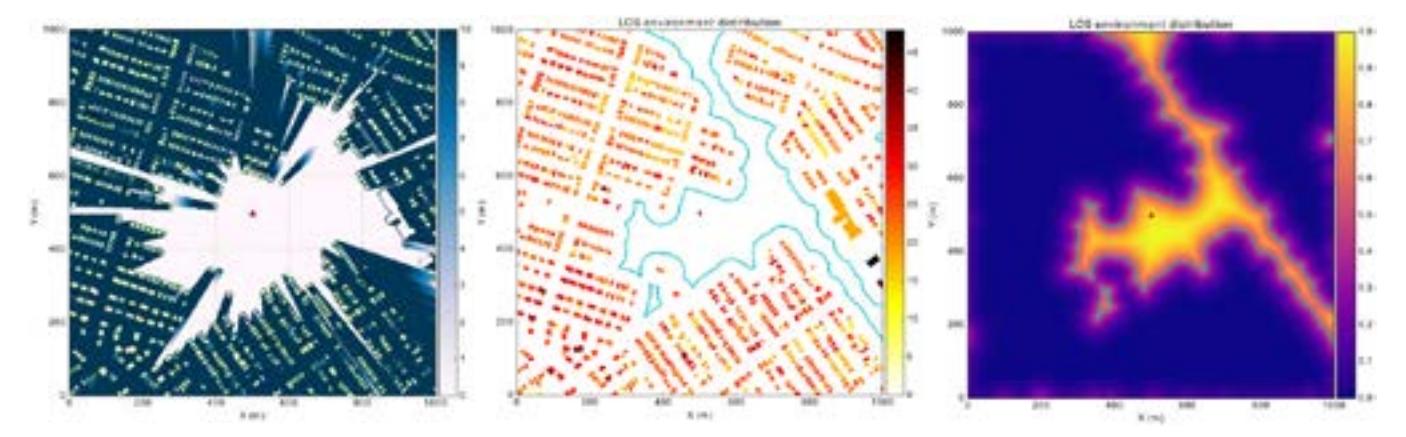
Three typical LOS conditions for different Manhattan city locations are illustrated in the Figure 1. Each set of images includes line-of-sight visibility around base station, building heights with buffer zones around them and the continuous distribution function (1) separating two LOS environments on each side of the buffer line
$$f(x)=1-\frac{1}{2}\left[1-erf\left(\frac{h(x)-\mu_h}{\sqrt{2}\sigma_h}\right)\right]\tag{1}$$A statistical line-of-sight visibility state model is proposed involving dual environments characterized by different obstacle heights. The method allows to combine two probability functions similar to those used by ITU and 3GPP models. This improves approximation accuracy with respect to deterministic LOS estimation using digital building model. From the comparison of 3GPP and dual environment model approximations applied to Manhattan city building data it is evident that dual environment model is more accurate for areas enclosing LOS visibility areas around base station. Advantages of dual environment LOS model is especially obvious for base station locations at the boundary of LOS and NLOS regions when antenna is placed on the rooftop of the buildings at the edge of city blocks. The only disadvantage of the proposed LOS model is increased complexity when at least two LOS probabilities are combined thus increasing the number of pLOS(d) coefficients. Dual environment approximation could be applied to other types of known LOS probability functions and more tests against diverse urban and suburban environments would enable reaching more quantitative results.