
The rise in usage of highly developed engineering materials such as composites increased the research interest in joining technologies. Compared to traditional methods such as mechanical fasteners; adhesive bonding is a well-known and advantageous joining technique. Adhesive joints offer to bond dissimilar materials, preserves joint material integrity (no fibre discontinuity unlike with rivets and bolts), and homogenous load distribution through the joint with high strength to weight ratio. However, there is still a huge concern regarding the reliability of adhesive bonding due to lack of knowledge obtained from non-destructive testing techniques. Therefore, this project focuses on the evaluation of bonding quality with different non-destructive testing (NDT) techniques.
The goal of the project is to determine the bonding quality with easy to access and verified NDT techniques with the integration of information from different methods. The work builds on three main steps: numerical investigation, experimental investigation, and statistical validation. Both numerical and experimental investigations had taken a place to analyse different quality, material type/stage, thickness and geometry of bonding. NDT methodologies namely ultrasonic, electromagnetic and thermography would be compared and integrated where possible.
This work objectifies to compare before mentioned NDT techniques quantitatively based on the probability of detection curves obtained from variety in bonding quality, material, and geometry. In addition to comparison, the information obtained from different NDT techniques would be integrated (data fusion). In the end, the project aims to optimize an overall technique to evaluate bonding quality.
The single lap joint with specific dimensions had been selected to analyse different bonding quality responses. Three different bonding quality had been investigated: perfect bond, disbond, and kissing bond (where adhesive and adherend is completely in contact with no shear force). For ultrasonic NDT, numerical simulation results agree with experimental investigations. They suggest that the parameters such as amplitude, frequency and phase change obtained from ultrasonic response curves are relatable with bonding quality. On the other hand, as a combination of two different NDT methods- eddy current and thermography- induction thermography results suggest that the temperature evaluation curve had been affected by the quality of bonding.
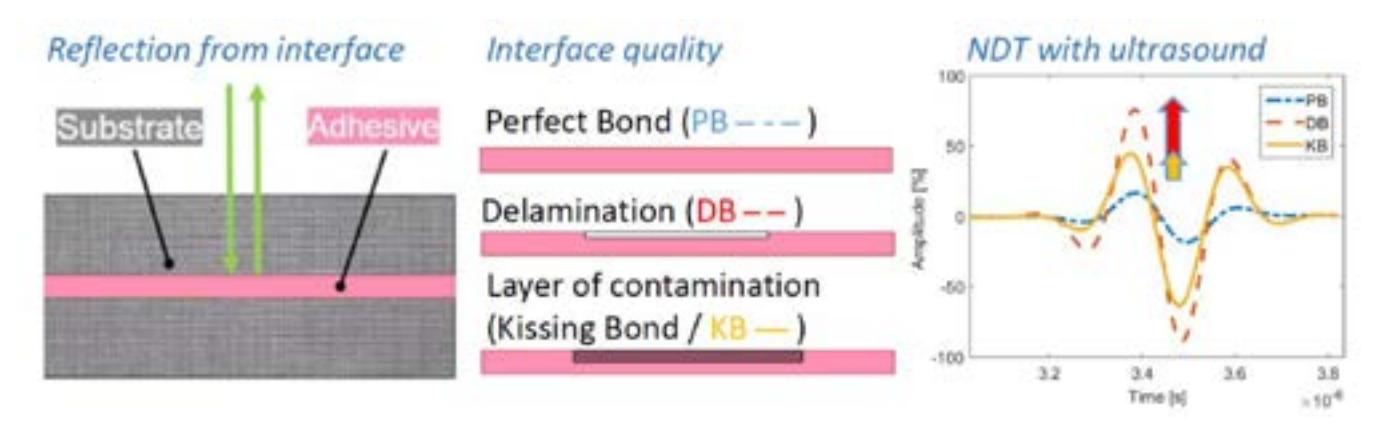
The parameters related to bonding can be identified with NDT techniques such as ultrasonic and electromagnetic. As a result, the bonding quality of the adhesive joints can be obtained. The reliability studies and validation of techniques with statistical methods such probability of detection (PoD) has been planned. In addition, quantitative comparison of different ultrasonic and electromagnetic techniques will be reported based on PoD curves. Where possible, the data fusion will be applied, in other words the responses from different NDT techniques will be integrated.