Carbacylamidophosphates (CAPh) are well known class of powerful chelating ligands which can be considered as structural analogues of β diketones. They can serve as an “antenna” for enhancing of Ln(III) luminescence by providing efficient absorption of energy and its transfer to the lanthanide ion [1]. The lanthanide complexes are intensively investigated as components of luminescent materials [2]. Besides the coordination to the metal ion and sensitization of the lanthanide 4f luminescence CAPh compounds are also known due to their wide range of biological activity [1].
The present study aimed synthesis and investigation of new luminescent mixed ligand lanthanide(III) complexes containing CAPh type ligand – dimethyl-N-benzoylamidophosphate (HL) – and the monodentate ligand triphenylphosphine oxide (TPPO) as an additional antenna. The coordination compounds under consideration were synthesized by the exchange-accession reactions from non-aqueous solutions according to the following scheme:
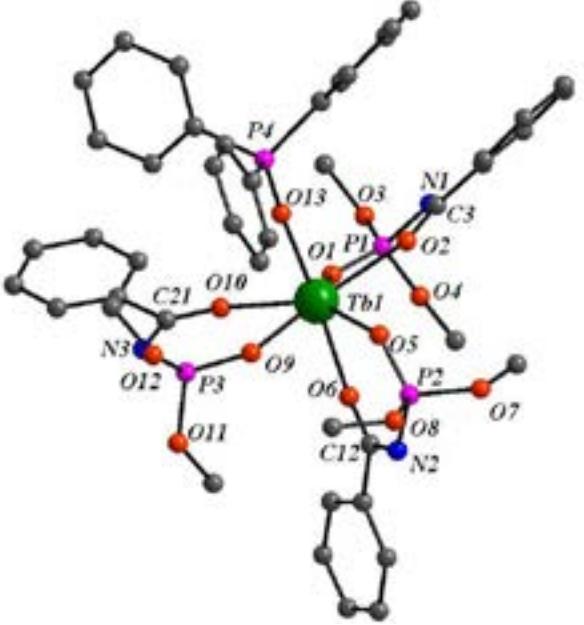
$$Ln(NO_3)_3 \cdot nH_2O + 3NaL + TPPO \rightarrow LnL_3TPPO + 3NaNO_3 + nH_2O$$The obtained complexes of the general formula LnL3TPPO ( Ln3+ = Pr3+, Nd3+, Eu3+, Gd3+, Tb3+, Lu3+) were characterized by X-ray and TG analysis, IR, 1H NMR, UV-Vis absorption and luminescent spectroscopy. By means of X-ray diffraction method for the complex TbL3TPPO (Fig. 1) it was found, that lanthanide(III) ion is bonded to three bidentate chelate CAPh-ligands through oxygen atoms of the carbonyl and phosphoryl groups and to the oxygen atom of one TPPO ligand completing coordination number of terbium ion to seven. The coordination environment of the central ion can be described as a distorted pentagonal bipyramid. The compound TbL3TPPO crystallizes in triclinic space group P-1, each unit cell contains two molecules of the complex. In crystal packing, there are numerous short contacts between neighboring molecules of the complex.