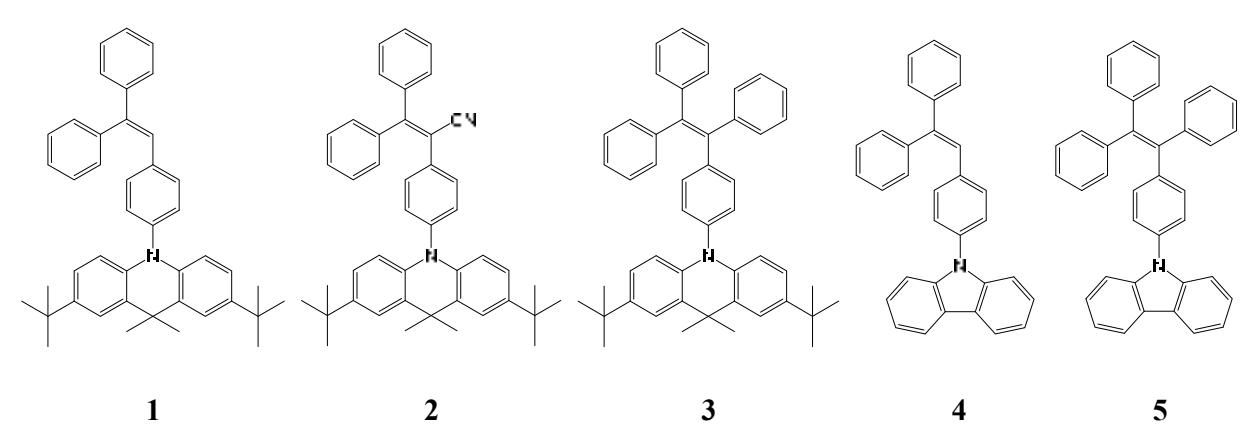
Development of inexpensive, reliable and effective organic fluorophores is one of the most intense research field in recent years due to their valuable applications in organic light-emitting diodes (OLEDs), light emitting organic field effect transistors and other optical devices. Many organic materials exhibit very high luminescence efficiency in dilute solutions, but become non-emissive or weakly emissive in the aggregate state, owing to the aggregation caused quenching [1]. Organic emissive materials are normally used in the form of thin solid films. Materials exhibiting aggregation-induced emission enhancement (AIEE) enable to develop high-performance OLEDs without the need of doping [2]. Despite significant progress of AIEE materials over the last decades, new fluorophores with good charge-transporting properties, high thermal and electrochemical stability are still in high demand.
In this work we report on new effective AIEE molecules synthesized via Buchwald-Hartwig coupling of carbazole or tert-butyl acridine and arylethylene moieties. The synthesized compounds were identified by IR, 1H NMR, 13C NMR spectroscopies and mass spectrometry. The thermal, photophysical and electrochemical properties of the compounds were studied. THF/water systems of various ratios were used to investigate aggregation effect on emission properties. Compounds were well soluble in THF but not soluble in water which led to the formation of molecular aggregates resulting in enhancement of the fluorescence intensity with increasing water fraction in the systems. For all the compounds except compound 2 fluorescence intensity started to grow dramatically when the content of water reached ca. 90%. This observation indicates the effect of AIEE. The synthesized fluorophores exhibit efficient emission in solid state with fluorescence intensity in the range of 445 – 724 nm and photoluminescence quantum yields reaching 86%. The compounds were found to possess high thermal stabilities with 5% weight loss temperatures exceeding 310°C. Compounds 1, 3 and 4 form glasses with glass transition temperatures at 188, 105 and 53°C respectively.