
Architectural textile (AT) consists of different layers combined with the matrix. The matrix can be made with yarns of natural or synthetic fibres. PVC (polyvinylchloride) coated polyester (PES) fabric is one of the most commonly used material in many modern architecture projects because of its excellent synergy of functionality and aesthetics [1]. The coating and fillers can protect the yarns against UV, abrasion, atmosphere, rainwater and moisture. CaCO3 and TiO2 are the dominant fillers in the PVC based AT production [2].
Polymers modified with the inorganic materials combine the functionalities of polymer matrices, such as a low weight and easy formability, with the unique features of inorganic materials. The inorganic materials improve its optical, mechanical, electrical, magnetic and rheological properties [3]. There is currently a great interest in AIBIIICVI2 semiconductor particles, for their importance as light harvesting materials [4]. The new structure could improve the efficiency of solar tracking made by photovoltaic panels.
In present investigation, we have tried to synthesize Ag-In-Se layers on AT (PES/PVC) surface. The surface properties of AT are important to silver-indium selenide layers adhesion and growth. Various surface properties as type and the density of surface charge, balance between the hydrophilicity and the hydrophobicity on surface, the chemical structure and functional groups, surface topography and roughness, the interfacial free energy could affect particles attachment and film growth.
AT-Ag-In-Se composites obtained by three-step assembly synthesis route. Firstly, for change physical surface properties the AT mechanical roughened and treated with etching solution [5]. Second, a chemical bath deposition method employed for preparation of AT-Se precursors at room temperature using $H_2SeO_3$ and $Na_2SO_3$ solutions. Third, this AT-Se further serves as proxies for silver-indium selenide formation. The formations of silver-indium selenide were attained by exposing the AT-Se into an $AgNO_3$ and $In(NO_3)_3$ solutions at room temperature. The reaction system depends on the heterogeneous reaction between $Ag^+$ and $In^{3+}$ ions and Se on AT surface. The obtained composites characterized by optical microscopy, mass fraction change of the deposited elements measurements, wettability measurements and X-ray diffraction analysis (XRD).
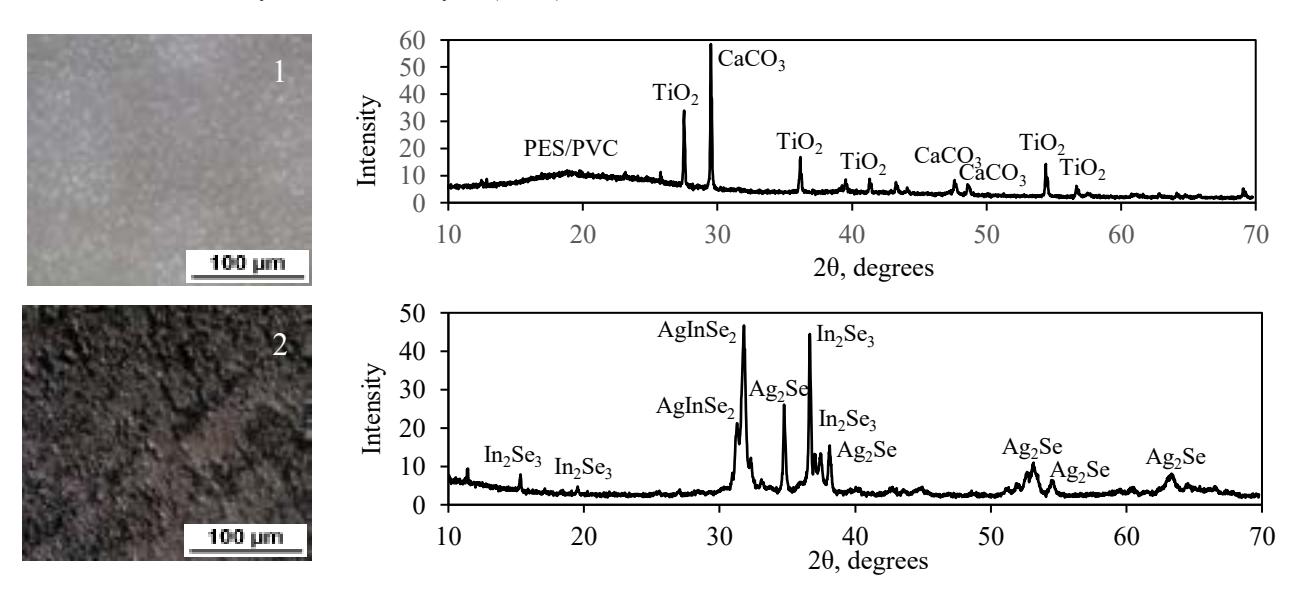
The prepared AT-Ag-In-Se composites are reproducible, uniformity of the surfaces increases with increasing immersions time in precursor's solutions. XRD analysis showed the formation of silver-indium selenide layers (Fig. 1).