Quantum dots (QDs) are attractive materials for use in photovoltaic systems, sensors, photocatalysts and as luminescent labels due to tunability of their properties by size, shape and surface chemistry [1]. Electrochemical methods provide efficient way to study charge transfer across QD/electrolyte interface in dark or under illumination and determine potentials of interfacial transfer which can be further related with electronic structure of QDs [2], [3].
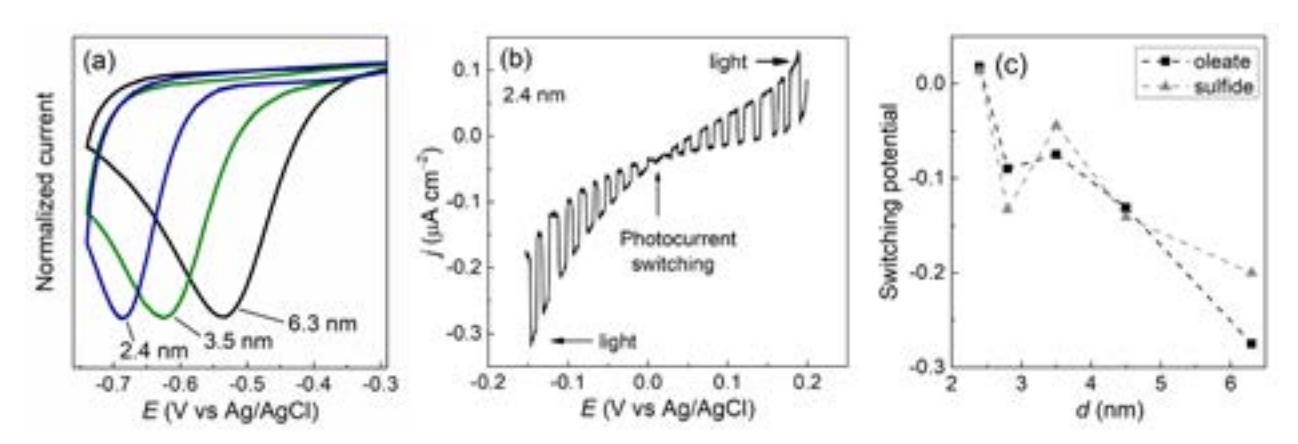
We have studied peculiarities of charge transfer on electrophoretically deposited films of CdSe QDs of variable size and capping ligand (oleate and sulfide) using Cd underpotential deposition (upd) as a probe reaction and studied their photoelectrochemical response in Na2SO3 solution. The Cd upd potential shows strong dependence on QD size (Fig. 1a). Oleate ligand replacement by sulfide enhances significantly efficiency of the charge transfer with this probe reaction on CdSe QDs.
Unlike bulk semiconductors, the QD film electrodes exhibit photocurrent switching phenomenon in potentiodynamic experiment with modulated illumination (Fig. 1b). The photocurrent switching consists in the transition between anodic and cathodic photocurrents controlled by the electrode potential. Both the oleate and sulfide-capped CdSe QDs show photocurrent switching (Fig. 1c) but quantum efficiency of the photocurrent was higher for QDs with sulfide capping.
The discovered effects are of interest as means of QDs characterization and quantification of the quantum confinement effect via electrochemistry.