Hydroxyapatites (HAp) and other calcium phosphates, being similar to a chemical composition of human's bone inorganic fraction, nowadays are mostly recognized and widely used biomaterials for bone and teeth renewal. Performing quality control, Ca and P molar ratio (Ca/P) serves as an underlying analytical parameter indicating HAp properties and suitability for implant production. Nowadays used methods for Ca/P determination (photometry [1], ICP-OES, gravimetry [2] and other), being well-established and easily accessible, still have some essential limitations. Accordingly, elaboration of a new simple and low-cost analytical procedure for quick and precise Ca/P ratio measuring is required.
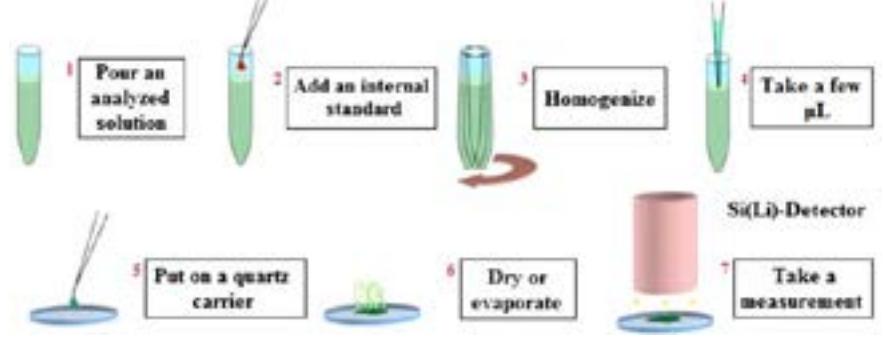
Data gathered during continuous investigation of different Ca/P determination methods showed that TXRF (Total Reflection X-ray Spectrometry) is the most applicable tool for this aim due to simple sample preparation procedure (see Fig. 1), relatively short one analysis time, multi-element analysis possibility and low hardware maintenance costs. Unlike classical WD/ED-XRF, TXRF is arranged in a special geometry - an incident beam impinges upon a sample below critical angle, making it much more sensitive technique. Until now TXRF method has been successfully applied to a great variety of different biological samples [3].
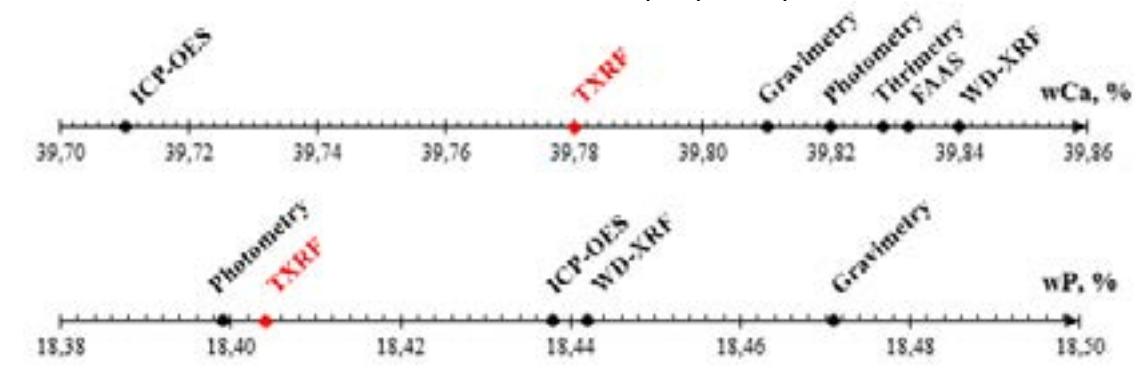
A key problem of TXRF is a small sensitivity of P analysis due to its relatively low $K\alpha$ line intensity. Other major drawback is difficulty in achieving uniform crystallization and distribution of sample containing elements putting analyzed solution on a quartz carrier and drying the droplet. Besides solving these problems, research also includes a suitable standard element for both element quantification and HAp solubility studies plus some validation basics (see Fig. 2) to make sure that TXRF method shows accurate calcium and phosphorus quantification results.