
An acid dissociation constant $pK_a$ is one of the key parameters of a chemical compound. This constant determines the protonation state of the compound for a given acidity of the solution, and this has profound ramifications in drug discovery and design. For example, biological activity of a drug can be greatly affected by the pH of the cell environment. Moreover, many organic compounds undergo reactions of tautomerisation, and have two or more different tatomeric forms, and therefore the control of drug efficiency can be an arduous task. Different tautomeric forms and protonation states affect overall bio-specificy of a compound in question. Experimental measurements of aqueous acidities of different tautomeric species is challenging and in many cases impossible. For this reason, the development of computational schemes for reliable prediction of these thermodynamic properties based on quantum chemical methods is of utmost importance.
The aim of this study is to assess the effect of tautomerisation on aqueous acidities by using quantum chemical methods rooted in density functional theory. A set of secondary benzenesulfonamides (Fig. 1.), including 4-amino-N-(1,3-oxazol-2-yl)benzenesulfonamide, 4-amino-N-cyanobenzenesulfonamide, N-[(4-aminophenyl)sulfonyl]acetamide, N-[(4-Aminophenyl)sulfonyl]benzamide, N-[(4-Aminophenyl)sulfonyl]-2-chloroacetamide, has been selected for analysis, the experimnental acidities of these compounds are taken from Ref. [1]. We have performed a comprehensive conformational analysis of all the compounds in different tautomeric and protonation states. All calculations were performed using M0-52X functional and cc-pVTZ basis set, and the SMD model was applied to account for solvation. Aqueous acidity and tautomeric equilibrium constants were calculated according to the direct thermodynamic cycle. Apparent constants have been evaluated to allow for direct comparison between experimental and computational results.
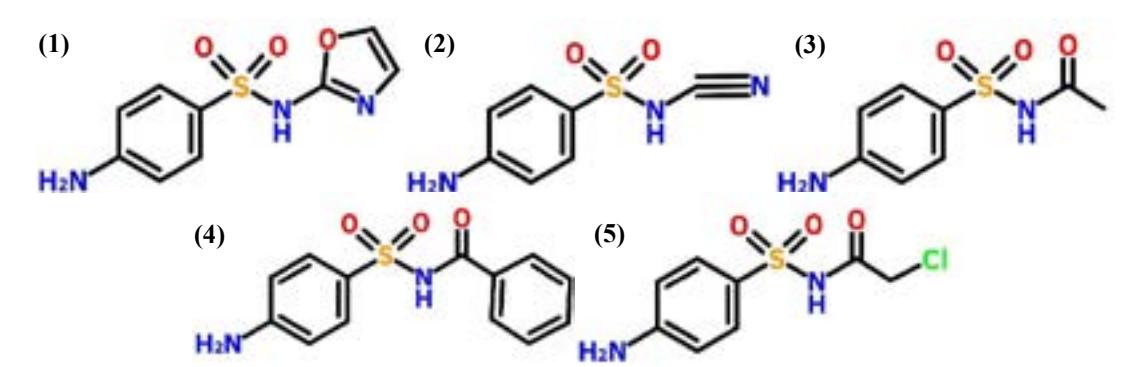
Our calculations show that amide-imidic acid tautomerism has negligible impact on the apparent acidity constants, as amide tautomer was in all cases found to be the dominating tautomeric form of N-[(4-aminophenyl)sulfonyl]acetamide, N-[(4-Aminophenyl)sulfonyl]benzamide, N-[(4-Aminophenyl)sulfonyl]-2-chloroacetamide compounds. On the other hand, we have found the canonical nitrile tautomer to be not the most stable form of 4-amino-N-cyanobenzenesulfonamide where imine tautomers are more stable. Our results thus show that a possible nitrile-imine and amine-imine tautomerism can not be ignored when aqueous acidities of benzensulfonamides are concerned.