
Robots are used in a variety of processes, including manufacturing, entertainment, services, and scientific research. To maintain a technical edge and thereby remain competitive, more and more businesses are applying advanced technical solutions in their operational processes. Such a wide application encourages the development of universal robotic systems and research into their capabilities and performance characteristics. Kuka-Youbot is one of the best known and widely distributed examples of universal robotic systems [1]. This modular robotic system was developed by KUKA as open source project for education and research. This system consists of two main modules: i) a robotic arm with 5 degrees of freedom, and ii) a omni-directional mobile platform. It can be assembled in various configurations, such as a stationary robotic arm, a mobile platform, a robotic arm mounted on a mobile platform and two robotic arms mounted on one mobile platform. Due to its design features and configuration possibilities, it is often used by researchers as a tool or as an object [2]. Using a robot for a specific task is dependent on its positioning accuracy (positioning error between stated and real position of arm end effector) and repeatability (positioning error between real positions of arm end effector performing repeating movements) and other parameters, which are considered to be a unique characteristics of the particular machine [3]. Modern industrial robots demonstrate high-level accuracy, yet they must be closely monitored and maintained to ensure that they continue to meet the conditions for which they have been programmed and in which they operate [4].
In our research, KUKA YouBot vibrations were measured and dynamics of this robot was evaluated. Vibrations of gripper were measured in tree perpendicular directions with accelerometers “Ini 603C01”. Experiments were performed in two different positions of robot arm. Experimental setup is shown in figure 1.
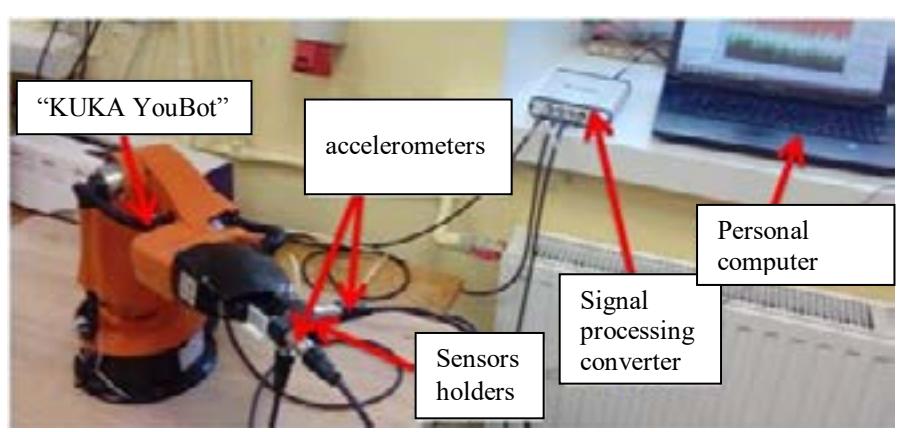
KUKA YouBot vibrations were measured with accelerometers “Ini 603C01" and signal was transferred to personal computer through signal processing converter “USB-4432" produced by “National Instruments” company. Later data was processed with “Origin 9.0” software package.