
The interaction between aerosol and atmospheric water (such as fog) can affect microphysical and chemical properties of atmospheric particles [1]. Nevertheless, there is lack of knowledge about changes in chemical composition and optical properties due to the fog. Several studies have proved the influence of fog on aerosol size and chemical composition [2]. The increasing frequency of fog in rising economy countries, characterized by high aerosol emissions, urges a better knowledge of aerosol-fog interaction.
We investigated aerosol optical properties in fall-wintertime in San Pietro Capofiume (rural background site) in the Po Valley. During experiments in November-December 2015, we deployed an Aerosol Mass Spectrometer (HR-TOF-AMS), a 7-wavelength Aethalometer, and an integrating Nephelometer (TSI). Ancillary measurements included liquid water content and the meteorological parameters (relative humidity, temperature and wind speed). We used Positive matrix factorization (PMF) of AMS organic aerosol mass spectra to further characterize the sources of ambient organic aerosol (OA). Furthermore, absorption Angström exponent (AAE), scattering Angström exponent (SAE) and single scattering albedo (SSA) were calculated.
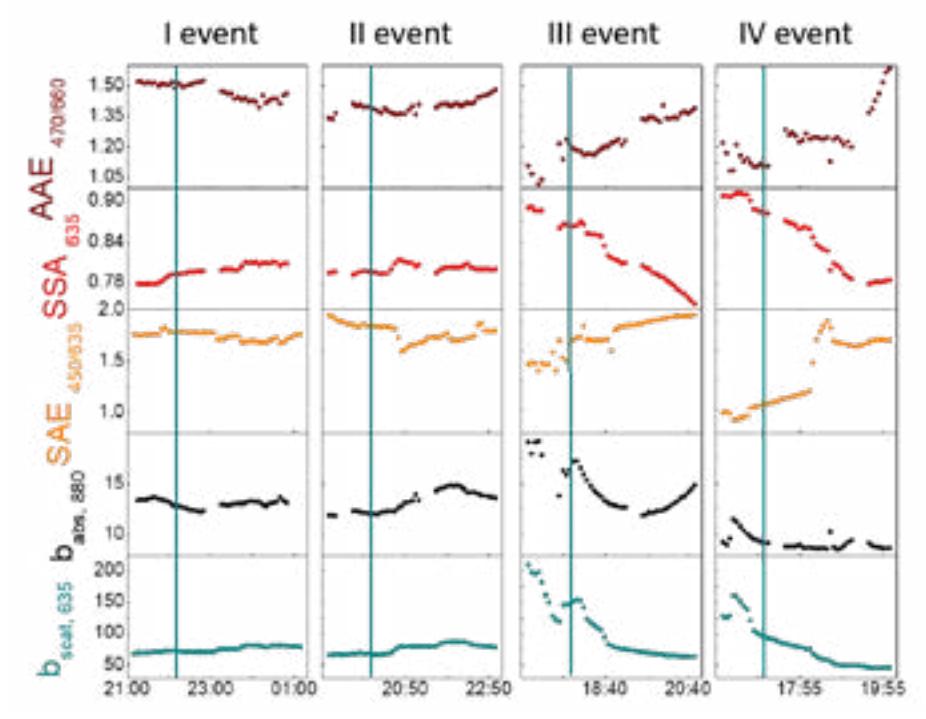
Three types of OA were observed: hydrocarbon-like organic aerosol (HOA), biomass burning organic aerosol (BBOA) and oxygenated organic aerosol (OOA). During 4 fog events the scavenging efficiency of OOA was the highest and varied between 37% and 57%. The changes in aerosol optical properties 1 h before and during the fog formation were observed (Fig 1). During all fog events, AAE followed changes of BBOA. Based on AAE and SAE values different mixed states were characterised. Main changes due to the fog appeared in SSA, followed by decrement by 0.07 unit during first 3 h after the fog formation. Identified changes in atmosphere due to the fog estimated by this study can be used to forecast the air quality at highly polluted areas with increasing fog frequency.