
Convolutional neural networks (CNNs) have been proven to perform fast object classification and detection on natural images and have the potential to infer astrophysical parameters on the exponentially increasing amount of sky-survey imaging data. The inference pipeline can be trained either from real human-annotated data or simulated mock observations. Until now, star cluster analysis was based on integral or resolved stellar photometry. This limits the amount of information that can be extracted from cluster images.
We aim to develop a CNN-based algorithm capable of simultaneously deriving ages, masses, and sizes of star clusters directly from multi-band images. We also aim to demonstrate CNN capabilities on low-mass semi-resolved star clusters in a low-signal-to-noise-ratio regime.
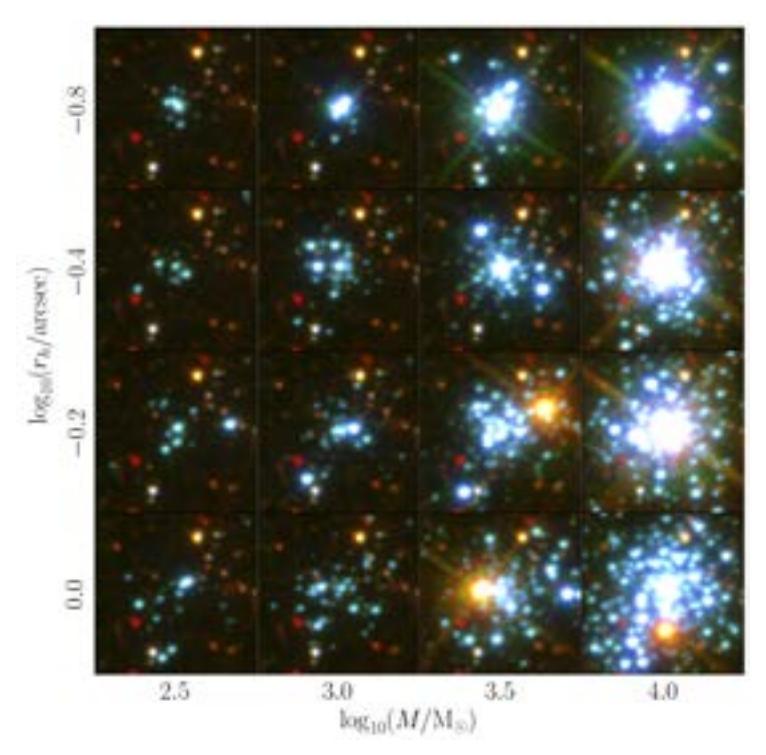
In this study a CNN was constructed based on the deep residual network (ResNet) architecture [1] and trained on simulated images of star clusters with various ages, masses, and sizes. To provide realistic backgrounds, star fields of M31 galaxy taken from The Panchromatic Hubble Andromeda Treasury (PHAT) survey [2] were added to the mock cluster images. Examples of generated clusters can be seen in Fig. 1.
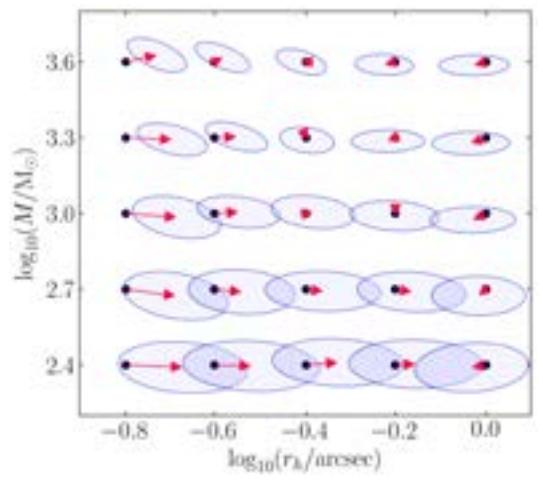
The proposed CNN was verified on mock images of artificial clusters and has demonstrated high precision and no significant bias (Fig. 2) for clusters of ages less than 3 Gyr, masses between 250 and 4000 $M_{\odot}$, and sizes ($r_h$) between 0.15 and 10 arcsec. The CNN-based cluster analysis pipeline is end-to-end, starting from input images all the way to the inferred parameters; no hand-coded steps have to be performed: estimates of parameters are provided by the neural network in one inferential step from raw images [3].
This allows both unresolved and semi-resolved cluster cases to be dealt with homogeneously, and multiple photometric passbands to be used in an integrated manner.