Multiferroic materials attract scientific interest because they exhibit ferroelectric and magnetic ordering in a single phase. Bismuth ferrite, BiFeO3 (BFO), shows ferroelectric (FE) and ferromagnetic (FM) ordering above room temperature [1]. In order to extend studies and investigate multiferroic materials BFO is doped with various elements (La, Nd, Sm, Gd and Cr). The following work is aimed to investigate the dielectric properties of chromium substituted bismuth ferrite ceramic (BiFe1-xCrxO3) by the impedance spectroscopy.
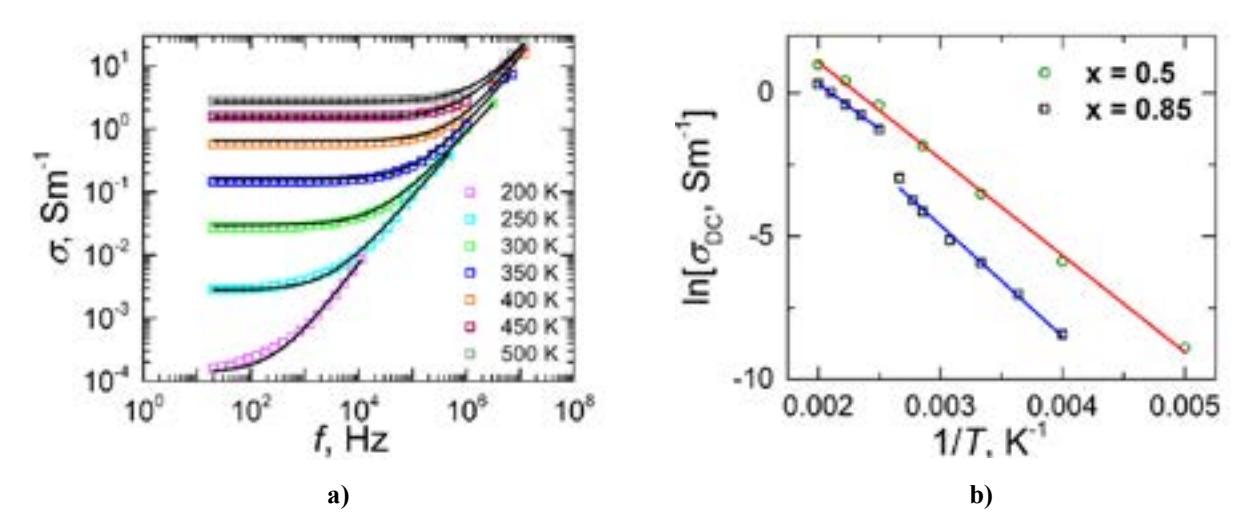
The electrical conductivity $\sigma^*$ is calculated using equation $\sigma^* = i\epsilon^*\epsilon_0\omega$. Fig 1(a) shows the frequency dependence of conductivity at different temperatures for the BiFe1-xCrxO3 ceramics (x = 0.5). The conductivity follows the Almond-West law [2] from which it is possible to determine DC conductivity. With decreasing Cr content the DC conductivity can be determined at lower temperatures in our measurements frequency range. For example, DC conductivity can be determined at 200 K for x = 0.5 and at 250 K for x = 0.85. From the $\sigma_{DC}$ values obtained at different temperatures the activation energy (EA) was calculated using the Arrhenius law $\sigma_{DC} = \sigma_0 \exp(-E_A/kT)$ (Fig. 1(b)). Obtained values are EA= 0.29 $\pm$ 0.01 eV (for x = 0.5), EA= 0.33 $\pm$ 0.01 eV and EA= 0.27 $\pm$ 0.01 eV (for x = 0.85). Sudden change of activation energy for x = 0.85 at 385 K is attributed to the phase transitions that occur near room temperature for the compositional range of 0.6 < x $\le$ 0.9 [3].