Molybdenum disulfide (MoS2) is a material that belongs to a class of chemical compounds called transition metal dichalcogenides. It has a graphene-like layered structure due to the strong bonds between metal and chalcogenide ligands, but relatively weak Van der Waals interactions between layers. These peculiarities lead to a wide use of MoS2 as a solid lubricant in machinery. From an academic point of view, it has been under research for its semicondutor, electro- and photocatalytic properties. MoS2 is considered as a promising alternative to a platinum cathode for hydrogen evolution reaction (HER) catalysis in acidic media. Recent research in the field has revealed the influence of the polymeric structure of amorphous MoS2 [1], as well as the several different active sites [2] on HER catalysis. The limiting step of the hydrogen evolution reaction on these materials is the Volmer adsorption step on the active sites of the cathode. The majority of these active sites in amorphous MoS2 are likely to be sulfur vacancies, i.e. unsaturated Mo sites. As one favorable way to form catalytically active MoS2, electrodeposition can be considered. It results in amorphous film growth with a large number of defects – sulfur vacancies. However, an amorphous structure hinders charge transfer, and thus has a negative impact on the electrochemical stability of the material. In order to improve the stability of MoS2 films, some sulfur atoms can be substituted with the similar selenium atoms, which are more conductive.
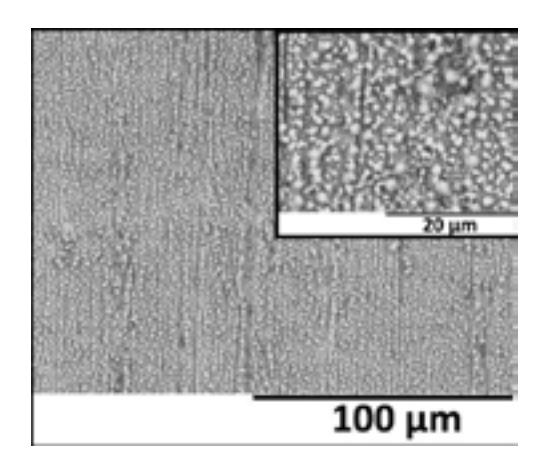
The electrodeposition of molybdenum sulfoselenides was carried out using a one-step deposition process from a common Mo, S, and Se ion precursors, which were synthesized from MoO42-, Na2S, and Na2Se. Chemical analysis confirmed that both S and Se were electrodeposited alongside with Mo. However, a large amount of oxygen is also present in the coating, which may indicate the formation of some oxides. The surface morphology of MoS2-nSen films reveals the scattered micrometer-sized crystallites (Fig. 1). The obtained films were also investigated for their HER electrocatalytic and photocatalytic properties.