
It is a well-known fact that imaging resolution defined by Rayleigh criterion is $\sqrt{2}$ times better for thermal light than for coherent light [1]. However, imaging resolution description in terms of Rayleigh criterion is suitable for direct image observation, but does not provide any understanding of the amount of information contained in the image, that can be gained by image post-processing. Development of resolution criteria based on informational approach is a rather popular topic today [2,3]. Yet, major researches in this field are aimed at studying imaging of uncorrelated (incoherent) sources in the subdiffraction limit (when the size of the whole imaged object is much smaller than Raleigh resolution).
In this study, we analyze imaging problem conditioning for the scheme shown in Fig. 1 (a). We make no assumption about size of the object, which is described by transmissions of its parts (pixels) $0 \le x_n \le 1$. Rotating ground glass disk, that generates pseudo-thermal light with varied coherence width $w_c$ is used as a source in the scheme. SPAD array detector is used to measure probabilities of the coincidence counts $p_{ij}$ of different detector pairs.
Using Fisher information matrix (FIM)
$$F_{mn} = \sum_{i,j} \frac{1}{p_{ij}} \frac{\partial p_{ij}}{x_m} \frac{\partial p_{ij}}{x_n} \tag{1}$$one can predict minimal error of extracting $x_n$ values from measured probabilities $p_{ij}$ on the basis of Cramer-Rao bound
$$\Delta^2(x_n) \ge [F^{-1}]_{nn} / N, \tag{2}$$where N is total number of joint detection events. Thus the total infidelity of object parameters $x_n$ estimation can be predicted as trace of inverse FIM $\sum_n \Delta^2(x_n) \ge \operatorname{Tr} F^{-1}/N$.
This approach allows to analyze imaging problem conditioning from informational point of view. Such an analysis is presented in Fig. 2 (b) (see description for details) and compared to results of experiment (Fig. 2 (c)). Theoretical analysis shows that for super-resolution regime there is an optimal coherence width $w_c$ that provides even better resolution than fully incoherent light ($w_c \rightarrow 0$), but for classical-resolution regimes incoherent source gives the best result. Value of the optimal coherence width was found to be about 1.5 size of the object pixel and being almost independent on the object shape. This prediction is in a good agreement with experimental data obtained for the same object and resolution regime.
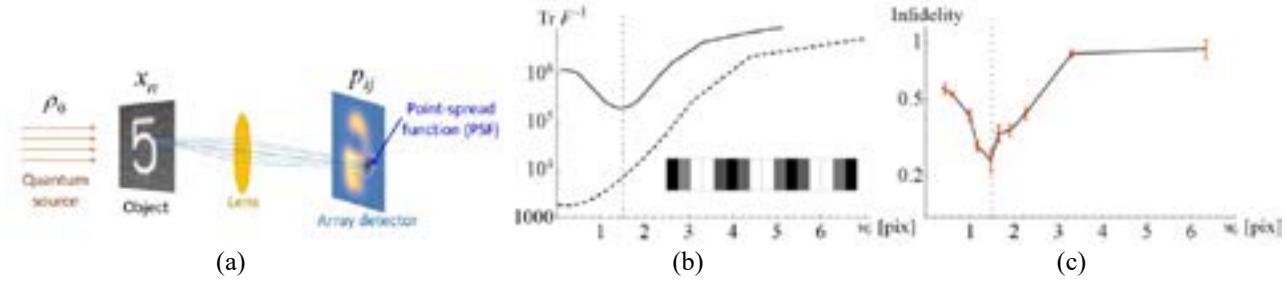
Existence of optimal coherence width $w_c$ is an interesting example of tradeoff between "quantumness" of the source and additional information obtained from interference effects, that exists only for finite $w_c$. Knowledge of this optimal coherence width allows us to perform more efficient imaging beyond Raleigh limit with limited measurement statistics.