
Graphene-oxide quantum dots (GOQDs) are nanomaterials with interesting and unique optical properties. Due to the small lateral dimensions, (less than 10 nm) and thanks to the luminescence properties, these materials can be exploited in many fields, such as organic light-emitting diodes, bioimaging and optical sensors [1]. Starting by different carbon allotropes, e.g. graphite, nanotubes, nanoflakes, it is possible to obtain GOQDs with different dimensions and oxidation degrees by chemical or physical oxidation. These reactions produce oxygen-containing functional groups, i.e. hydroxyl (-OH), carboxylic (–COOH) and epoxy groups, located on the carbon basal plane and at the edges of the nanosheets. As a consequence, a large number of sp3 carbon atoms and lattice defects is available in the GO structure. The result is the opening of the graphene optical bandgap with a consequent blue emission that could be exploited for many applications.
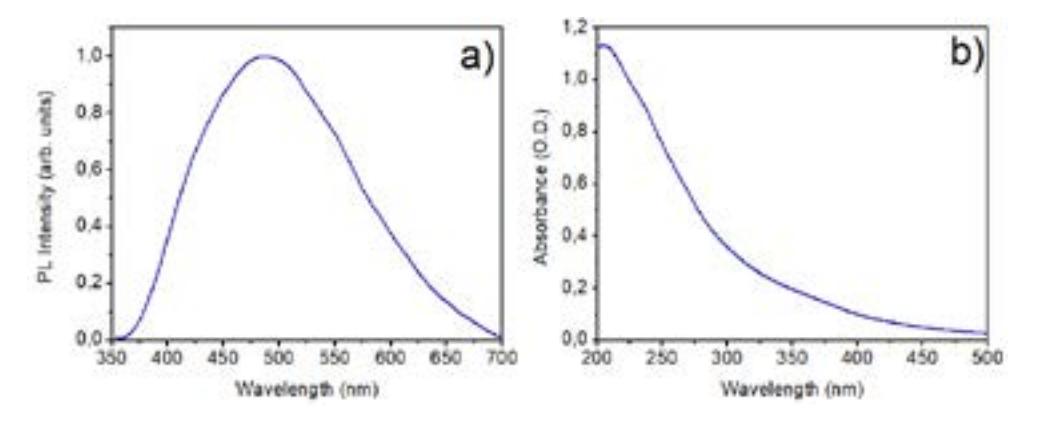
We have synthesized a new type of GOQDs in water solution starting by C60 Buckminster fullerene using concentrated sulphuric acid (H2SO4) and nitric acid (HNO3). Compared to the previous oxidation method [2], this strategy reduces the number of involved chemicals and requires a simple and direct procedure. The GOQDs photoluminescence (after excitation at 300 nm) and the absorption spectra are shown in the figure 1.
Heavy metal ions in water interacting with the oxygen functional groups of the GOQDs structure can produce a variation of the photoluminescence spectrum with a quenching or an enhancement of the emission intensity [3-5]. Thanks to the change of the photoluminescence intensity is therefore possible to detect the presence of heavy metal ions in water and, in some cases, even to distinguish the type of ions. [6]. Heavy metals, in fact, can be very dangereous for the environment and for human health [7], for this reason it is necessary to monitor their presence in water and soil. In comparison to other systems, optical sensors are very promising for their stability, selectivity and absence of electrical noise. In conclusion, with an easy and low cost synthesis of luminescent GOQDs in water, a simple system to detect heavy metalions in water can obtained based on optical methods.