
Adhesively bonded joints of dissimilar materials such as carbon fibre reinforced plastic (CFRP) bonded to steel have a great interest of use in aerospace, automobile, marine, wind turbine industries. The main advantages in using such joints are because they are lightweight, have increased mechanical performance, corrosion resistance, high fatigue strength, uniform stress distribution, better damage tolerance, impact resistance [1], [2]. Delaminations between two dissimilar materials are the most common defects that affect the integrity of entire structure and can cause a great harm for human safety. Therefore, such structures have to be checked regularly in order to detect defects, assess the risk the defects can cause and the possibility of further use or repair of the structure [3].
The aim of this work was to investigate possibilities to detect delaminations in adhesively bonded steel to CFRP joints. The scope of work is as follows: analysis of sample characteristics, simulation of ultrasonic inspection, experimental inspections. There are three main methods to detect delaminations in dissimilar material joints: amplitude change of interface reflections, back wall reflection loss, and phase reversal [2]. Firstly, characteristics of the sample and artificial delaminations were analysed. The sample under inspection has a simple planar geometry. Bulk waves were selected according to the thickness of dissimilar materials. Delaminations are artificial and made of Teflon with oil to prevent bonding of layers.
Simulations of inspection of the sample in contact pulse echo mode using 5 MHz transducer were performed for all three existing delaminations in the sample using CIVA software. Inspection from metal side was selected since CFRP is 3 times more attenuating material than steel. Amplitudes of signals reflected from the interface with good bonding and with delamination were compared. It was determined, that the difference is only 0.6 dB. From this, it follows that in practice it will be hard to detect delaminations. In this case, multiple reflections from the interface were analysed to increase probability of defect detection. From results of simulation, the difference of subsequent reflected signal, amplitudes are growing from 3 dB and more so, the defects can be located more easily in practice. The next step was an experimental sample inspection in contact pulse echo mode using 5MHz phased array transducer. To detect delaminations from the first reflection from the interface was hard in A-scan, but analysing subsequent reflections the difference was more obvious in amplitude scale. Inspection in immersion pulse echo mode was performed as well using 10 MHz focused transducer to increase the accuracy of the results on sample interface. It was determined that 2nd reflection from the interface is the most appropriate to analyse, since the difference in amplitude from good and defected bond is higher comparing to 1st and subsequent reflections. In this case, C-scan of the inspection of delaminations was obtained and shown in Fig. 1.
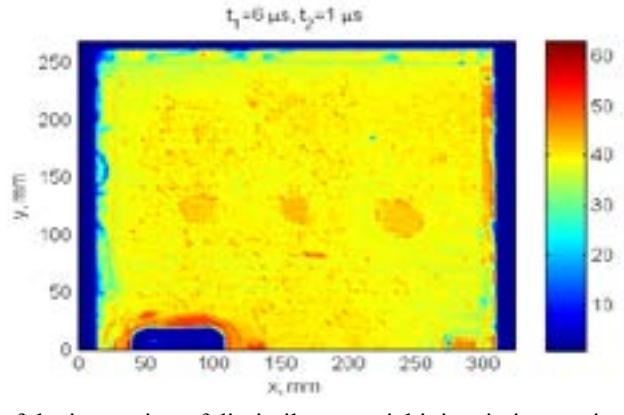
As a result, three artificial delaminations were detected using contact and immersion pulse echo mode inspection. It was determined that 2nd reflection from the interface should be analysed when inspecting joints of dissimilar materials.