Finite-element models for describing three-dimensional stress-strain state of a multielement system “car tire-asphalt concrete" have great practical importance in car and road industry for determination assessment of volume damageability and wear of tire and the asphalt concrete pavement, which work in conditions of contact, mechanical and sliding fatigue.
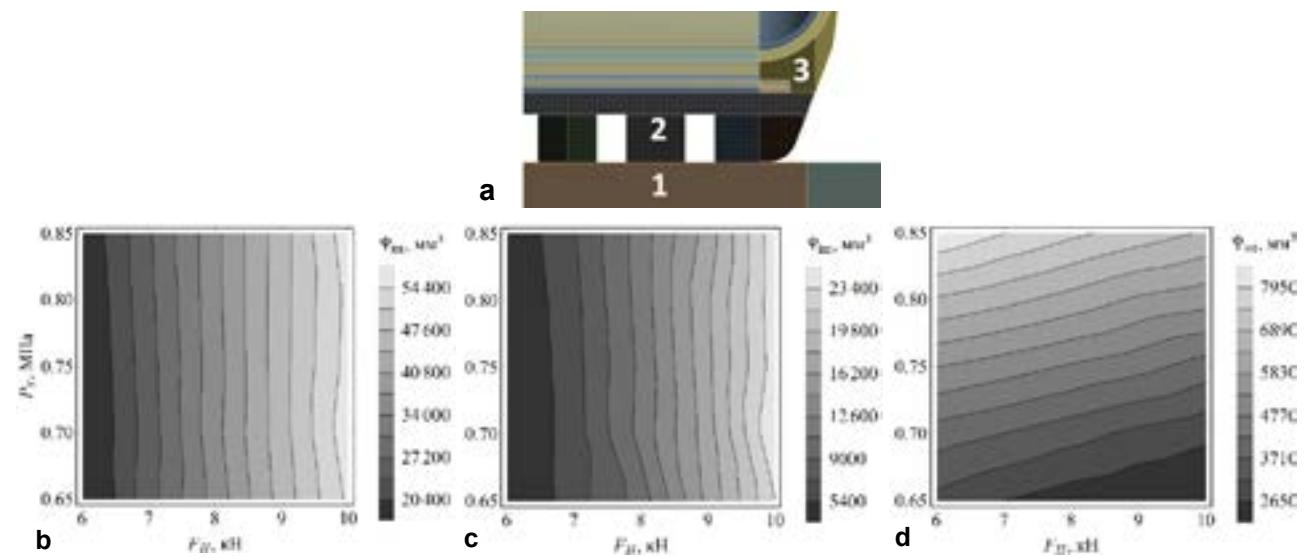
In this work simultaneous contact interactions of the full multielement system “car tire—asphalt concrete”, loaded by the various tire inner pressure $P_S$ (from 0.65 to 0.85 MPa) and radial load $F_H$ (from 6 to 10 kN) on rim were modelled using finite-element method [1,2]. The main goal of this work is determine 3D stress-strain state of the whole system and the state of volumetric damageability in contact interaction area of tire and asphalt concrete, where maximum stresses occur: 1) asphalt concrete, 2) tire tread and 3) rubber under radial ply (fig. 1-a).
Calculation of damageability $\Psi_{\text{int}}$ is based on the model of deformable solid mechanics with dangerous volume [3]. According to this model dangerous volume $V_{\text{int}}$ is the volume where acting stresses $\sigma_{\text{int}}$ are greater than limiting stress $\sigma_{\text{int}}^{(\text{lim})}$. Allowable limit stress by stress intensity for friction fatigue in contact zone of tire and asphalt is 0.5 MPa and for others rubber parts of tire is 1 MPa which work in conditions of mechanical fatigue.
$$\psi_{\text{int}} = \sigma_{\text{int}} / \sigma_{\text{int}}^{(\text{lim})},\tag{1}$$ $$V_{\text{int}} = \iiint_{\Psi_{\text{int}}(V) \ge 1} dV , \qquad \tag{2}$$ $$\Psi_{\text{int}} = \iiint_{\Psi_{\text{int}}(V) \ge 1} \Psi_{\text{int}}(V) dV.\tag{3}$$Damageability in tire tread and asphalt concrete (fig. 1-b and 1-c) increased 3.3–3.6 and 6.6–8.2 times when the radial load on rim is increased from 6 to 10 kN. However, damageability in rubber under radial ply (fig. 1-d) decreased by 17–34%, which may be due to the complex nature of the stress redistribution in this area. Damageability in tire tread and asphalt concrete increased by 1–3% and 3–30% when the tire inner pressure is increased from 0.65 to 0.85 MPa, except the rubber under radial ply where damageability increased 2.7–3.4 times, because this zone experiences large bending loads with a radial load on the rim in the condition of interaction with the radial ply and steel breaker. Maximum value of damageability in rubber under ply is 8412 mm3 ($P_S = 0.85$ MPa, $F_H = 6$ kN) and minimal is 2022 mm3 ($P_S = 0.65$ MPa, $F_H = 10$ kN). Minimal and maximum value of damageability for tire tread and asphalt concrete can be found in [2].