Even though ferroelectric relaxors were discovered over 60 years ago the physics of their unusual characteristics remain not completely understood which leads to an ongoing investigation of their dielectric properties. Such materials have a high value of dielectric constant and a wide dielectric anomaly as well as dispersion in a wide range of frequencies. In contribution to all the research on relaxor ferroelectric materials, the dielectric spectroscopy of lanthanum doped PMN-10PT was carried out.
Silver paste electrodes were applied on both surfaces of a ceramic sample after polishing it. Then the sample was heated up to 750 K. Measurements were performed on a cooling cycle at the rate of 1 K/min in 120 – 500 K temperature range and 20 Hz – 1 GHz frequency range. Capacity and loss tangent were measured using HP-4284A impedance analyzer while the vector analyzer Agilent 8714ET was used to measure complex reflection coefficient. For measurements in temperatures below 300 K liquid nitrogen was used. The temperature was registered by either T-type thermocouple or platinum 100 $\Omega$ resistor.
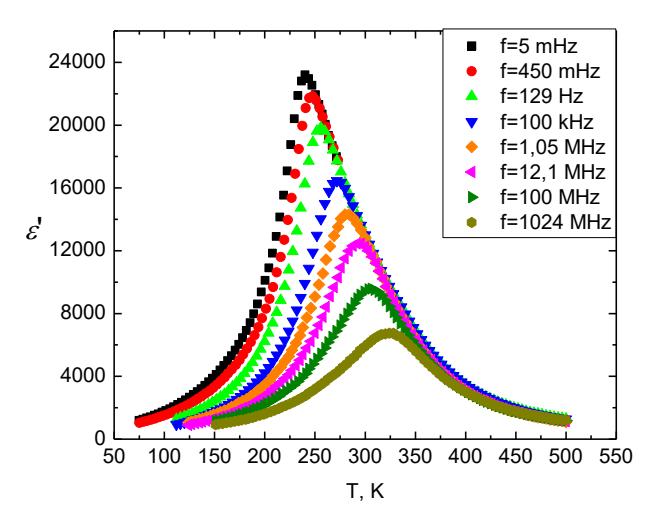
Fig. 1 shows the temperature dependence of the real part of dielectric permittivity of PMN-10PT 2% La sample. The characteristics of the relaxor ferroelectric are clearly seen. The dielectric anomaly is wide and the maximum of dielectric constant shifts to higher temperature as the frequency increases. Such behavior of the dielectric constant is believed to be characterized by small (a few nanometers in size) polarized islands called the polar nanoregions (PNR), that appear upon cooling as the material transforms into the ergodic relaxor (ER) from the non-polar paraelectric (PE) phase.