
The main objective of the present study was to assess the environmental genotoxicity using different bioindicators (Mollusca, Arthropoda, and Chordata phyla) collected at 14 study stations in the Gulf of Riga. The levels of nuclear abnormalities (micronuclei (MN) and nuclear buds (NB)) were evaluated in peripheral blood erythrocytes of flounder (Platichthys flesus), herring (Clupea harengus), and eelpout (Zoarces viviparous), in gill cells of the Baltic clam (Macoma balthica) and for the first time in gill cells of isopods Saduria entomon. Environmental genotoxicity risk in the Gulf of Riga was assessed using MN responses in three fish species and clams.
Blood samples were collected from 88 P. flesus, 89 C. harengus, and 22 Z. viviparous specimens caught during r/v "Walther Herwig" sampling cruise using standard bottom or pelagic trawls. Gills were dissected from 84 of M. balthica and 42 of S. entomon specimens sampled with the Van Veen grab (0.1 m2) according to the HELCOM guidelines during r/v "Aranda" sampling campaign.
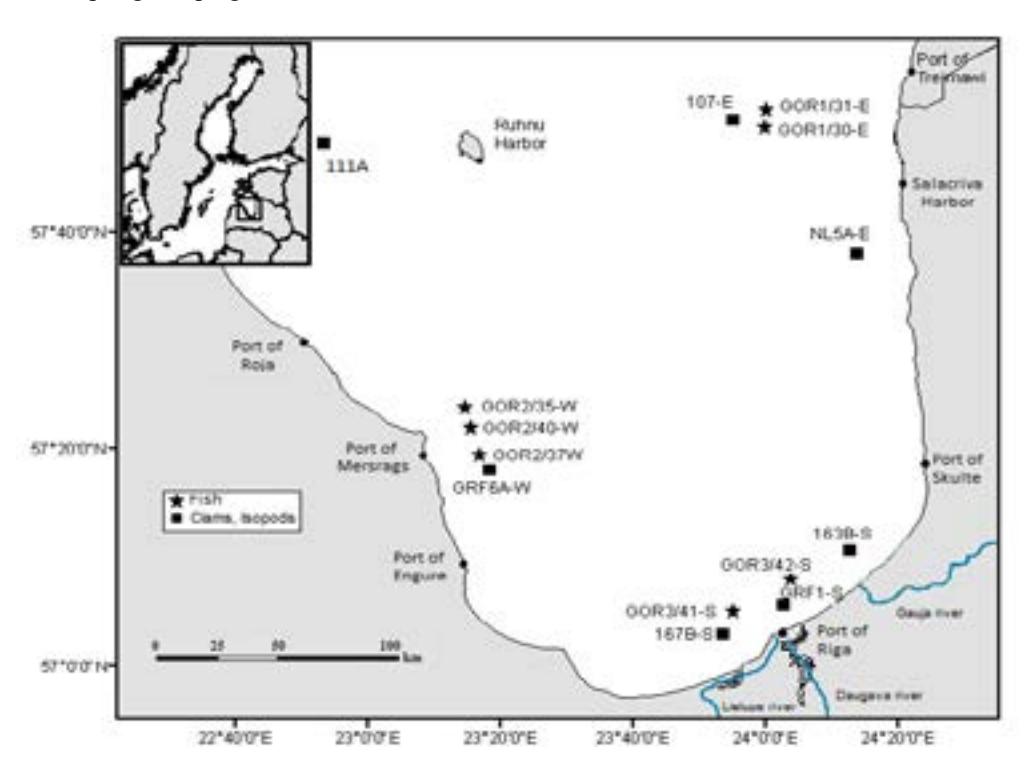
Increased frequency of MN and NB in organisms from investigated sites of the Gulf of Riga indicates the presence of pollution with genotoxic agents. The highest frequency of micronuclei (MN/1000 cells) was detected in eelpout caught at station GOR3/41-S and was equal to 0.68‰, in herring at GOR3/41-S station (0.38‰), in flounder at GOR2/37-W (0.61‰). In all three fish species caught at station GOR1/30-E, the highest induction of nuclear buds (NB) was determined with the gradient of NB responses in fish - eelpout (0.37‰) < herring (0.47‰) < flounder (0.84‰).
The highest induction of MN and NB in gill cells of M. balthica and S. entomon was recorded in specimens from station 111A, which is located on the open sea in Gulf of Riga (offshore sea zone). The frequency of MN in clams was equal to 6.1‰, in isopods, 4.59‰. Both species caught at the same station revealed the highest values of nuclear buds (4.69‰ in clams, 6.09‰ in isopods). The lowest MN incidences (0.94‰) were registered in isopods from station 107-E. Moreover, isopods from station 107-E revealed the lowest level of NB (0.72‰).
The environmental genotoxicity risk was assessed using four different bioindicators (three fish species and clams) collected in the Gulf of Riga. The highest genotoxicity risk was determined in 8 out of 14 study stations investigated in the Gulf of Riga Analysis of MN levels revealed an exceptionally high risk for flounder inhabiting four out of seven stations, for eelpout one out of three stations, and for clams collected from four out of seven study stations. Low genotoxicity risk level, according to four different bioindicators, was attributed for eelpout and only in one station.
According to elevated MN responses in fish (herring and eelpout) and the risk assessment (there were found exceptionally high risk levels for flounder, eelpout, and clams), southern coastal area of Gulf of Riga could be considered as the most affected by genotoxin's pollution. The highest induction of NB in all investigated fish species was at station GOR1/30-E (eastern coastal area).