Most of the photosensitive resins for optical 3D printing are made from acrylic oligomers, acrylic monomers and/or reactive diluents, photoinitiators and UV stabilizators/blockers [1]. Petroleum-derived acrylic resins such as polyesters, polyether oligomers or diglicidylether bisphenol A acrylates are those that are mostly used for optical 3D printing [2]. Since petroleum recourses are decreaasing, it became crucial to search for alternative materials such as renewable resources Due to natural oils richness in double bonds which can be polymerized or converted to other functional groups, biodegradability and renewability, natural oils became a popular target of researchers [3].
Soybean oil is one of the most promising materials to replace petroleum-derived resins [4]. Due to the high amount of various functional groups such as the acrylic, epoxy and hydroxy groups, acrylated epoxidized soybean oil (AESO) is widely used in industry. AESO can be polymerized by UV/VIS light using appropriate photoinitiators and can form a cross-linked polymer network while the cross-linking of pure AESO is still considerable.
Vanillin dimethacrylate (VDM) or methacrylated vanillin alcohol is produced from lignin, one of the most abundant natural polymers. The bio-based thermosets made from VDM and maleinated AESO showed good thermal and mechanical properties, yet very long reaction time was also observed [5]. Vanillin diacrylate (VDA) is a bifunctional aromatic compound which can also be produced from lignin. It has two acrylic groups which can be polymerized via free-radical polymerization, yet no data was found of its usage in polymerization.
In this study, the plant-derived AESO, VDM and VDA were used as photosensitive monomers for the optical 3D printing. Chemical structure of the cross-linked polymers was confirmed by IR spectroscopy. The insoluble fraction of the cross-linked polymers was determined by Soxhlet extraction. Mechanical testing of the cross-linked polymer specimen was performed by compression test on a BDO-FB0.5TH (Zwick/Roell) testing machine. Thermogravimetrical analysis was conducted on a Perkin Elmer TGA 4000 instrument. Differential scanning calorimetry analysis was performed on TA Universal DSC Q2000 V24.10 Build 122 instrument. Direct Laser Writing (DLW) 3D lithography experiments were conducted employing a Pharos laser (515 nm, 300 fs, 200 kHz, Light Conversion Ltd). The fabricated structures were characterized using a scanning electron microscope (SEM, Hitachi TM-1000).
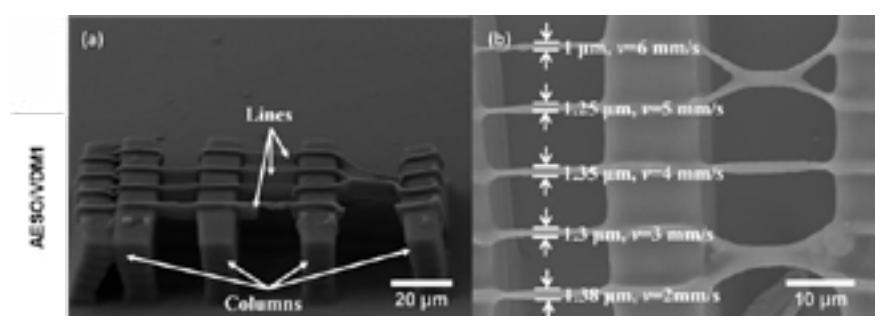
It was determined that the addition of VDM reduced the rate of photocross-linking and the values of the glass transition temperature, thermal decomposition temperature and compressive modulus. The formation of more linear and/or branched macromolecules considered the VDM effect as a plasticizer for AESO in photocross-linking without a photoinitiator. It was experimentally demonstrated that the homopolymer of AESO and the copolymer AESO/VDM are suitable materials for rapid 3D microstructuring by the DLW lithography technique, shown in Fig. 1. [6]