
Organic single crystals with long-range molecular order ensure high carrier mobility, enhanced photochemical and thermal stability as well as negligible light-scattering, what makes them attractive as an optical gain medium for electrically-pumped organic lasers [1]. Unfortunately, amplified spontaneous emission (ASE) thresholds of the crystals are typically more than one order of magnitude higher as compared to those of amorphous neat or doped films. In our previous works we have been able to significantly reduce ASE threshold of organic crystals by employing rational design of bifluorene-based compounds that has enabled a control of intermolecular coupling realizing high radiative rates and high fluorescence quantum yield (QYPL > 0.8) in the sublimation-grown single crystals [2]. In depth investigation of intermolecular coupling revealed strongly anisotropic and exceptionally high exciton diffusion (D = 1 cm2/s) in crystal direction referring to the highest dipole coupling [3].
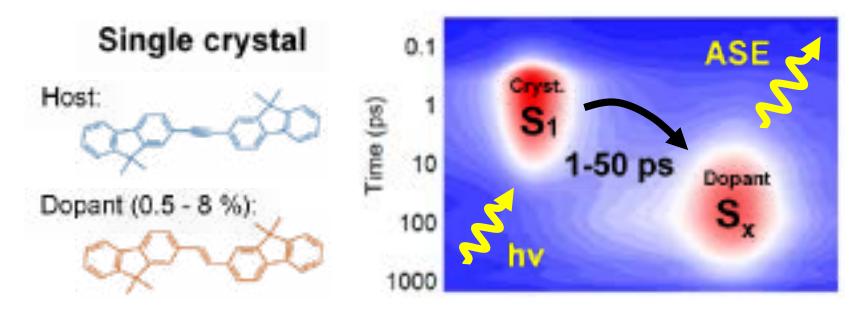
Considering the pronounced exciton diffusion in bifluorene crystals our further work was focused on crystal doping (see fig. 1), which allowed an even further reduction of ASE threshold to a record value (400 W/cm2 or 2 μJ/cm2) [4]. Finally, our most recent work addresses triplet formation and ASE threshold as a function of doping concentration, which would be important for continuous wave laser applications.