
Thin nanostructured manganite-cobaltite films can be applied as room temperature B-scalar magnetic field sensors. Undoped La1-xSrxMnO3 films have high metal-insulator transition temperatures (Tm), the substitution of Co for Mn in La1-xSrxMn1-yCoyO3 (LSMCO) lowers Tm, increases the resistivity and gives expectively higher values of magnetoresistance at the room temperature [1].
Pulsed-injection metalorganic chemical vapor deposition (PI-MOCVD) method was used for the deposition of thin nanostructured (on Al2O3 substrate) and textured (on LaAlO3 substrate) La1-xSrx(Mn1-yCoy)zO3 (x=0.18, z=1.15) films. The novelty of the research is not only the certain doping level of Co, but also the nonstoichiometry of Mn leading to the change of structural, transport and magnetic properties of the LSMCO films
In present study, it was determined that with the increase of Co content (up to 0.16) results in the decrease of metal-insulator transition temperature (Tm) (Figure 1a). The metal-insulator transition temperature Tm is related to the transfer integral between the manganese ions and thus to the angle of the Mn3+-O2--Mn4+ bonds. The substitution of Co for Mn presumably destroys these bonds and thus weakens the double-exchange interaction [2]. However, the increase of Co improves the magnetoresistive properties of the LSMCO films: increase of magnetoresistance with Co content up to magnetic fields of 60 T.
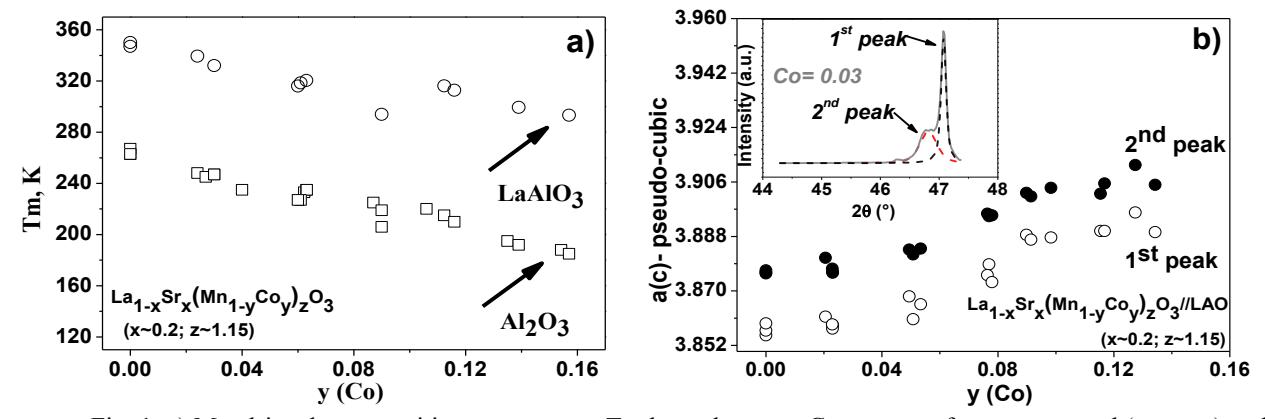
X-ray diffraction (XRD) data revealed that all samples are single-phase. The lattice parameters were determined by the XRD patterns (Figure 1b). Substitution of Mn by Co results in systematic increase in lattice parameters of textured films with the increase of Co content. This dependence may be explained by epitaxial strain or/and oxygen vacancies.
The composition of the films and exact doping level of Co was determined by inductively coupled plasma mass spectrometry (ICP-MS). Electrical and magnetic properties of LSMCO films were investigated by using a low dc electric field and pulsed magnetic fields up to 60T. Structural analysis was determined by X-ray diffraction (XRD). Surface morphology was studied by scanning electron microscopy (SEM).
The possibility to apply the manganite-cobaltite films for the development of B-scalar magnetic field sensors is considered.