Wideband ultrasound is a powerful diagnostic tool for advanced applications such as biomedical high-resolution high-contrast imaging and non-destructive analysis [1,2]. Number of studies of ultrasonic transducers have been conducted because ultrasonics offers very high-resolution diagnostics due to the relatively small speed of sound within the most part of liquids and solids. But, there are some limitations for effective ultrasound generation. Conventional piezoelectric are quite bulky, low-speed and unreliable. Furthermore, the attenuation of ultrasound is very high even at the sub-gigahertz frequencies [2,3]. Thus, the minimal thickness of the active layer within the ultrasound generator is required. However, wideband ultrasound can be generated by irradiating the optical absorber with a modulated optical signal in order to create, by conversion of optical power into heat, a rapid and localized temperature fluctuations [1-3]. These fluctuations in turn produces mechanical oscillations with ultrasound frequencies by thermal expansion. Fiber-optic generators based on the photoacoustic effect are very small, flexible and movable. Moreover, they are characterized by high electromagnetic immunity, dielectric design and chemical durability [4]. Nanostructures on the surface of an optical fiber edge are able provide very high absorbtion (up to 90%) within the thickness of nanoparticle (NP) monolayer. In our previous papers [4,5], it is shown that absorbed optical power can be higher than 50 mW for surface Au and Ag nanostructures. Due to very high absorbtion of modulated laser radiation, nanostructure thermal failure can occur. Moreover, in the case of water surrounding, boiling as well as cavitation processes are takes place near the nanostructure, limiting the performance of the fiber-optic photoacoustic transduser. In this paper we present theoretical investigation of thermophysical limitations for fiber-optic photoacoustic transdusers based on nanostructures.
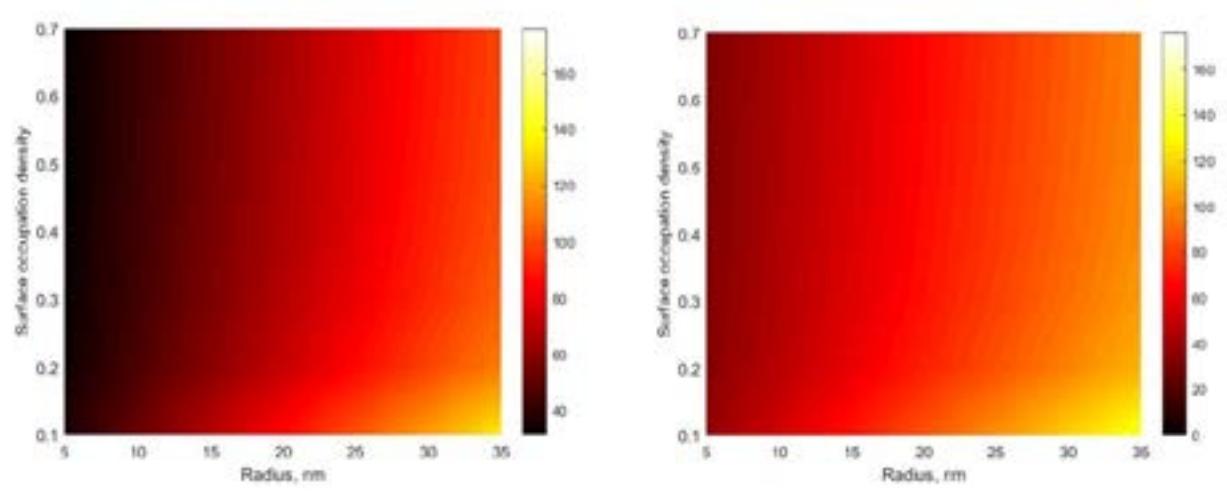
It is assumed that absorbtion of laser radiation by the monolayer of noble metal nanoparticles takes place in water surrounding. Au and Ag NPs are deposited on the surface of the optical fiber edge. The simulation of the nanostructure temperature variation is performed in time by means the CST Microwave Studio Student Edition. The unit cell of the NP monolayer contains two infinite osculating parallelepipeds, one of them is optical fiber edge and another is water surrounding. NP is placed within the interface region between the surface and surrounding on the surface of the substrate. The contact between the NP and fiber core is located only in surface plane, assuming the NP volume to be wholly placed into the water. Spatial optical power density is assumed to be constant. Fig. 1. shows maximal temperature within the nanostructure on the optical fiber edge under illumination with laser vs NP radius and surface occupation density for Ag and Au based nanostructure. One can see that increasing of surface occupation density results in decreasing of the maximal temperature, at the same time radius increasing in turn leads to temperature increasing. Thus, in the worst case of 50 mW absorbed power, thermal effects do not limit the performance of the fiber-optic photoacoustic transduser based on Ag NPs with radius less than 25 nm and Ag NPs with radius less than 20 nm.