
Indium tin oxide (ITO) is a tin-doped In2O3. It is a n-type wide-bandgap semiconductor, widely used as transparent conducting oxide (TCO). However, due to indium shortcomings and toxicity issues, rapid research for new type TCOs began.
Recently, ternary semiconducting oxides AII2BIVO4 attracted tremendous interest and Zn2SnO4 (also known as zinc tin oxide or ZTO) is considered to be one of the most perspective TCO. According to Kawazoe et al. [1], linear chains of edge sharing octahedra running along the <110> direction leads to formation of an extended conduction band, therefore higher electron conductivity is expected, not to mention good transparency, low cost and non-toxicity.
Nevertheless, obtaining thin ZTO film without any residual zinc or tin oxide is quite challenging. Currently used growth methods for ZTO films encounter this problem or the growth conditions are inflexible due to limitations of the method itself. MOCVD method has pliable deposition conditions, which can be optimized to grow pure ZTO films and change their properties relatively easily.
The aim of this work was to find the optimal conditions for the growth of single phase ZTO thin films by Pulse-Injection Metalorganic Chemical Vapour Deposition (PI-MOCVD) method. Additionally, ZTO films were grown on differently cut sapphire substrates and their optical and electrical properties were investigated.
For the deposition of thin ZTO films Zn(thd)2 and Sn(thd)2 (thd - 2,2,6,6-tetramethyl-3,5-heptandionate) precursors were dissolved in 1,2-dimethoxyethane and injected to the reaction chamber in micro doses. Impact of deposition conditions (such as concentration of oxygen in gas flow, volume of gas flow, pressure during the deposition, etc.) to the properties of the films was explored. The composition of thin ZTO films was determined by Energy Dispersive X-ray Spectroscopy (EDX). Film phase composition was examined with X-ray Diffraction (XRD) and morphology - with Atomic Force Microscope (AFM) and Scanning electron Microscope (SEM).
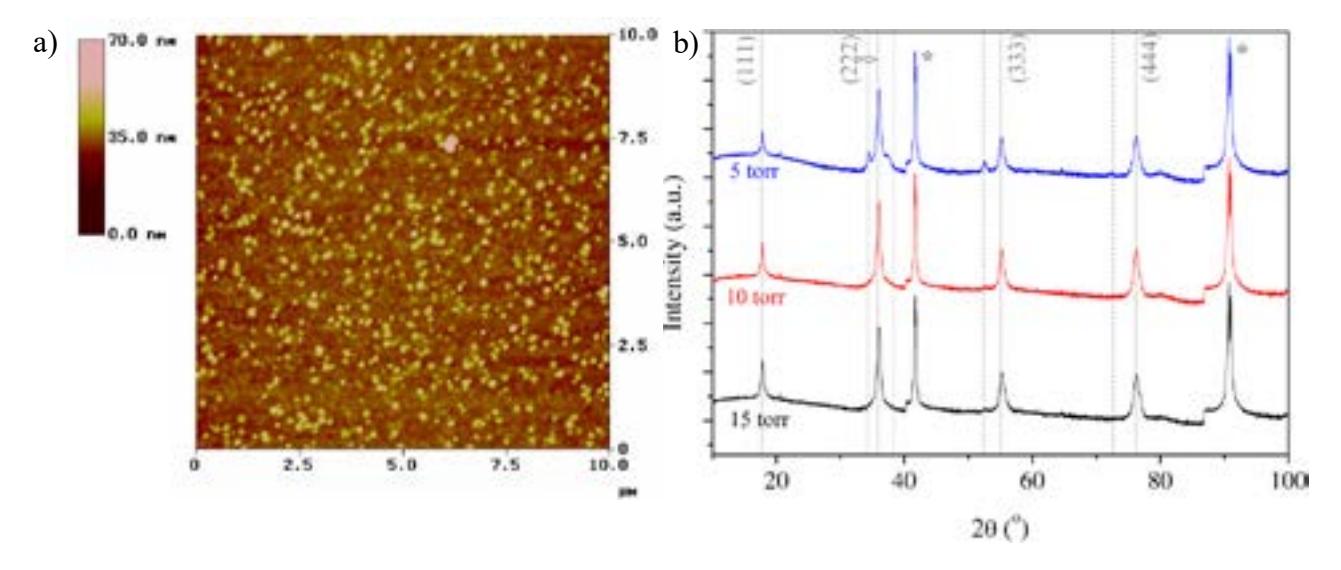
To our knowledge, single phase thin $Zn_2SnO_4$ films were grown on sapphire substrates by PI-MOCVD for the first time (Fig. 1). In order to obtain a pure crystal phase of $Zn_2SnO_4$ (without any other crystal phases), zinc surplus in film was necessary. Additionally, the transparency and conductivity of the films were measured and band gap ($E_g$) was calculated.