
One of the most important tasks of modern nanotechnologies is the development of relatively inexpensive selective methods for the synthesis of new nanoscale structures and nanomaterials with new physical properties, as well as the generation of various functional devices based on them [1-2].
In this work, we obtained nanocoating based on semiconducting C60 fullerene in the volume of the evaporating droplet on the surface of the mica substrate, for the first time.
A new accelerated method for the synthesis of nC60 aggregates of a spherical shape from fullerene C60 molecules has been developed and implemented (where n is the number of fullerene C60 molecules in the synthesized aggregate). The method is based on the self-organization of C60 molecules in the volume of the evaporating drop of the fullerene solution in N-methylpyrrolidone at room temperature. On the basis of the proposed method, a thin semiconductor fullerene C60 (with a band gap of ~1.6 eV) coating with a thickness of ~800÷1000 nm was obtained, for the first time (see. Fig.1). In the experiment, the initial concentration of C60 in the molecular solution in N-methylpyrrolidone was ~1.04 mol/m3. It has been established that the most likely motive force for the self-organization of C60 molecules in an evaporating droplet volume of solution due to the thermal action is the presence of strong temperature gradients both in the volume and in the near-surface layers of the evaporating drop. The physical mechanism of self-organization of fullerene molecules and formation of large nanoaggregates, so-called Ostwald ripening, according to which relatively large structures grow at the expense of smaller ones, has been proposed [3].
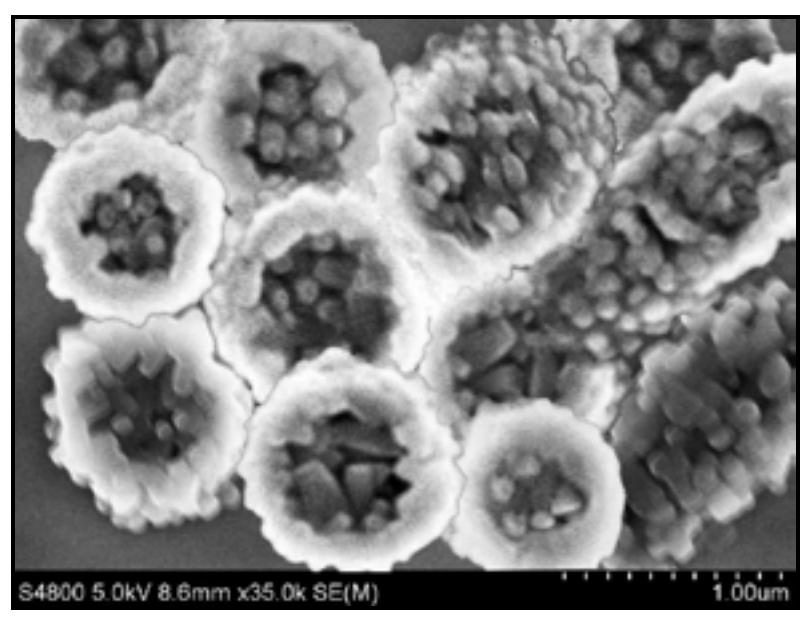
The most important factor determining the ordering of C60 molecules and the formation of nC60 nanoaggregates in the volume of evaporating droplets is the velocity of the contact line along the substrate, depending on the type of organic solvent used in the preparation of the initial C60 solution. Prolonged microscopic observations of self-aggregation processes of C60 in the experiments have allowed establishing that synthesized thin nanocoating of aggregates were stable to external mechanical and thermal influences. The proposed method can be used for the synthesis of nanosized thin two-dimensional (2-D) films based on C60 molecules on the substrate surface in solar energy as a photoactive layer for high-efficiency solar cells, in optics as a photosensitive sensor, in nonlinear optics as an effective optical limiters of laser radiation and others.