
Radiocarbon (14C) is a long-lived carbon isotope that has a half-life of $5730 \pm 40$ years. 14C is produced naturally by cosmic radiation in the upper atmosphere. Nuclear power plants are one of the main producers of anthropogenic 14C. In nuclear reactors, the formation of radiocarbon takes place in the coolant, the cooling system of the control and safety rod channels, fuel elements and graphite brickwork [1]. Anthropogenic radiocarbon can be released into the environment in gaseous forms, with liquid releases or with spent nuclear fuel.
During photosynthesis radiocarbon can be easily assimilated into the plants. As a result, 14C can be transported through the food chain and accumulate in a human body. Therefore, radiocarbon is considered a primary source of increased human radiation dose from industrial nuclear activities [2].
The aim of this research was to evaluate the impact of anthropogenic 14C contamination from Ignalina NPP (INPP) on the Lake Drūkšiai (the Ignalina Nuclear Power Plant cooling pond) system. The lake sediment and vendace (Coregonus albula) scale samples were collected from the Drūkšiai lake. The ages of sediment layers were estimated using 137Cs and 210Pb dating methods. ABA (acid-base-acid) chemical pretreatment procedure was used to extract humin (HM) and humic acid (HA) fractions from the sediments. Chemically pretreated samples were graphitized with the Automated Graphitization Equipment AGE 3 (IonPlus AG). Radiocarbon measurements in prepared samples were performed using the single stage accelerator mass spectrometer (SSAMS, NEC, USA).
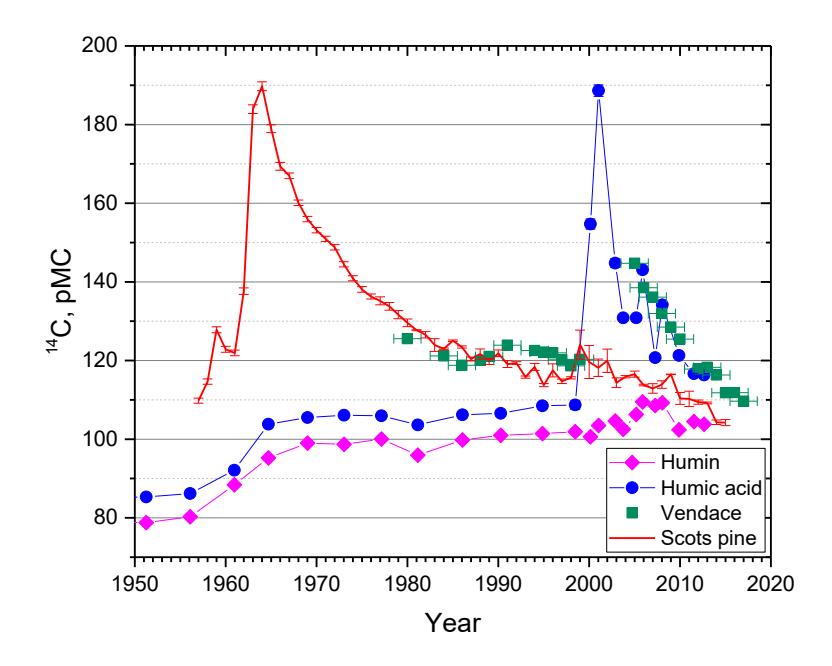
14C measurements in HM and HA fractions showed that after the start of the operation of the INPP in 1983, the radiocarbon concentration in these organic fractions increased by 3.86 pMC and 2.6 pMC, respectively (Fig. 1). Furthermore, 14C content in vendace scales increased from 121.2 pMC (in 1984) to 123.9 pMC (in 1991).
In 1999s, there is a sharp increase of 14C concentration (by 79.89 pMC) in HA fraction. In the same year, an increase of radiocarbon content in the Scots pine (Pinus sylvestris) near the INPP was also observed [3]. Since 2001, 14C activities in vendace scales are similar to those in HA. The 14C enriched organic matter that was released from the INPP in 1999s was incorporated into the food chain and then accumulated both in sediments and fish.