
The microfluidics-based electroporation technique is rapidly developing [1]. This technique is advanced with its unique characteristics of miniaturization and integration, but it is still difficult to study fast, nanoscale pore formation dynamics using real-time fluorescent microscopy. In order to perform such experiments, the electrode structures, which are capable of trapping cells with the usage of dielectrophoretic forces is required. Dielectrophoresis (DEP) is the phenomenon described by Pohl [2] as the creation of forces on neutral, but polarizable particles when they are exposed to nonuniform electric fields.
The DEP force is specified via an electric potential or the electric field and depends on the electric field gradient frequency and particle property. Under the proper geometry and electrical parameters set-up, the DEP force can be used for trapping single particles between electrodes, which would allow to observe electroporation phenomena dynamics using real-time fluorescent microscopy.
In this work we study the configuration of planar electrodes and electric field distribution using finite element method (FEM) analysis (see Fig. 1). It is aimed to determine the proper electric field distribution for the effective DEP force application. A multiparametric investigation of the four electrodes topology is performed in COMSOL Multiphysics environment to define the configuration of electrodes and electric field distribution, which would ensure a proper DEP force exposure on the selected cells for the research.
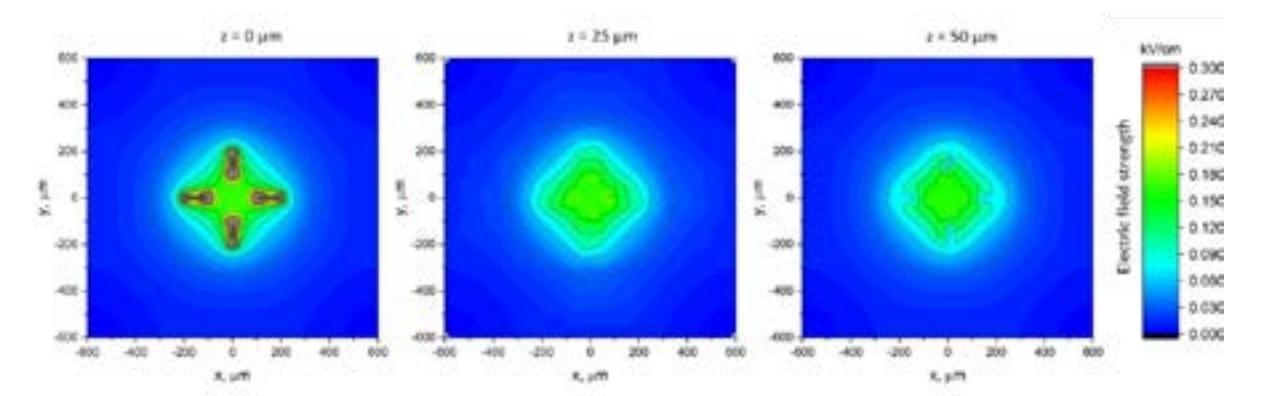
The generated electric field intensity and homogeneity dependency on the electrodes configuration is evaluated and the optimal configuration is proposed, which would be further used to study the effectiveness of DEP force application in the real-time electroporation investigation.