
Sodium alginate (AL) is a salt of alginic acid, a linear polysaccharide composed of 1,4-linked β-D-mannuronic acid and α-L-guluronic acid residues. Due to its gelling properties, biocompatibility, non-toxicity, biodegradability, AL is the most extensively studied material for the preparation of polymeric membrane dressings.
In this study, calcium alginate with immobilized lidocaine hydrochloride (Ca-AL-LiDHCl) and hybrid membranes with hyaluronic acid (Ca-AL-HA-LiDHCl) were prepared. Polymeric membranes were plasticized by glycerol and further cross-linked with divalent ions using calcium lactate as a source of calcium ions.
The thickness of the membranes was measured with a micrometer (293 MDC-MX, Mitutoyo Co., Kawasaki, Japan). The results showed that HA affected the thickness of the prepared membrane dressings. Ca-AL-HA-LiDHCl membranes were slightly thicker due to HA ability to absorb and hold water, as supposed. The thickness of prepared Ca-AL-HA-LiDHCl and Ca-AL-LiDHCl membranes was 0.38 mm and 0.35 mm, respectively.
The mechanical properties were determined using a universal material testing machine Zwick/Roell BDO-FB 0.5 TH (Zwick, GmbH & Co, Ulm, Germany). The strips of the films had a length of 7 cm and a width of 2 cm. Computer Software V11.02 TestXpert provided the percentage elongation at break (EB, %) and tensile strength (TS, MPa) values. The results showed that HA considerably increased elongation at break values, as compared with Ca-AL-LiDHCl (Fig. 1.).
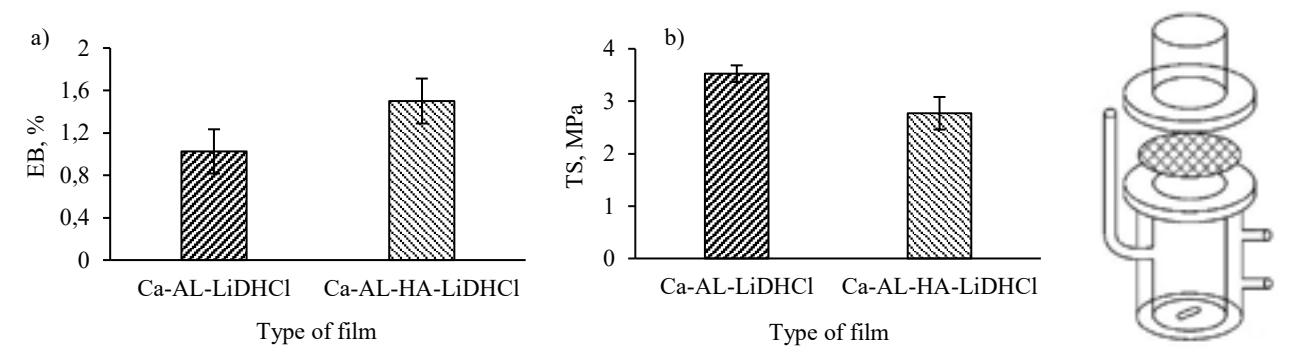
LiDHCl release kinetics from hybrid membranes was carried out using Franz cell (Fig. 2.). The amount of released drug was determined spectrophotometrically (Cary 50 UV–VIS, Varian, Inc., Netherlands). The release profile of LiDHCl from Ca-AL-HA-LiDHCl and Ca-AL-LiDHCl hybrid membranes in a 0.9 % NaCl solution at 37 °C showed that 50% of total LiDHCl was released after 6 h.