
The productivity and competitiveness of agricultural production are highly dependent on the climate, which is changing faster than predicted. The challenges of adapting the agricultural sector to climate change include not only the growth of crop products, but also the conservation of soil and water resources [1]. Climate change in Lithuania in 2017 occurred with 1.5-1.9 times higher precipitation amount compared to perennial precipitation amount. The opposite result was in 2018 as the air temperature was 2°C higher than perennial air temperature and natural drought was recorded. Therefore, in order to predict the impact of the changing climate on agriculture and environment, the 2016, 2017 and 2018 climate conditions allowed to design two different scenarios and assess their impact on organic soils. This is very important because organic soils are rich in organic carbon (SOC) and organic nitrogen (SON) [2]. As a result, climate change can affect not only CO2 emission from organic soils, but also increase Nmin (ammonium and nitrate nitrogen) amount [3].
To achieve the goal, 9 sites were selected in different places in Lithuania (3 locations: Vepriai - 54°02'59N,61°26'36E; Perloja - 52°81'88N,60°10'19E; Piktupėnai - 37°13'74N,61°14'42). In each location, three platforms with a maximum of 10x10 meters were selected according to the exact GPS coordinates. Soil samples were taken from them, one soil sample from the probe was taken from 4 - 6 places.
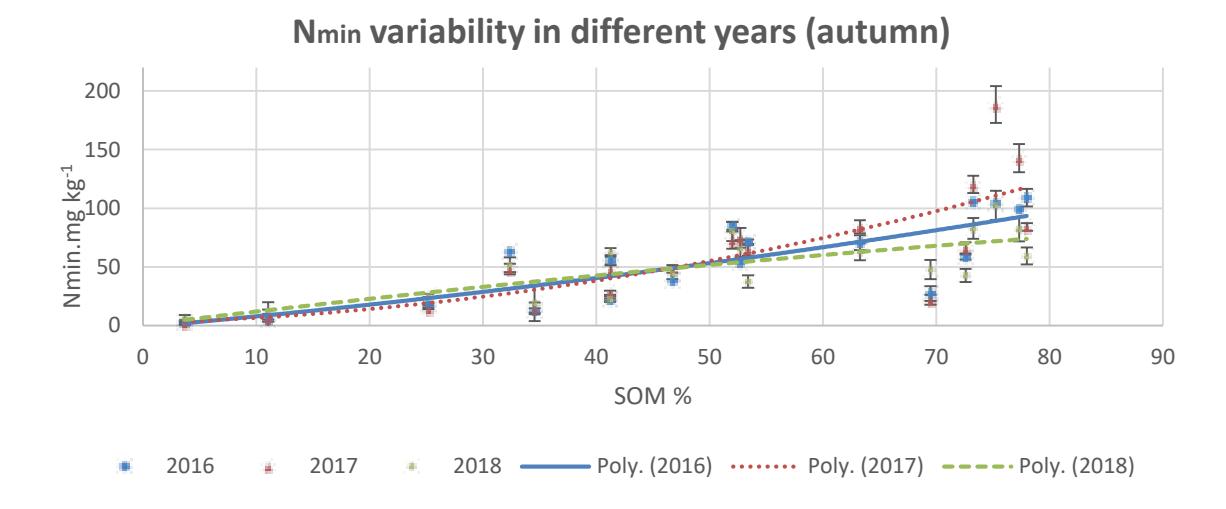
The assessment of the study results showed not only relationship between SOM and $N_{min}$ but also $N_{min}$ dependence on different climate conditions. These results showed that although in 2017 fixed $N_{min}$ amount was the lowest - $2.6 \pm 0.9$ at $\geq 40\%$ SOC compared to other years, but at 60-80% SOM $N_{min}$ amount was the highest - $153 \pm 18.3$, and this was influenced by precipitation. The 2017 reliability curve is y = $0.0045x^2 + 0.8651x - 1.309$ for the $R^2 = 0.649$ reliability score. Conversely, high air temperatures were recorded in 2018 and low precipitation resulted in a higher $N_{min}$ amount - $4.2 \pm 1.5$ at $\geq 40\%$ SOM but at 60-80% SOM $N_{min}$ amount was the lowest - $84 \pm 14.6$. The reliability curve is y = $-0.0029x^2 + 1.1699x + 0.4988$ for $R^2 = 0.5883$ reliability score. In 2016 $N_{min}$ amount was $3.2 \pm 0.7$ at $\geq 40\%$ SOM, and at 60-80% SOM $N_{min}$ amount was $97.2 \pm 12.9$.
Therefore, when predicting $N_{min}$ change scenario in organic soils, the research results can provide that if the climate change increases precipitation but the air temperature will not increase, then $N_{min}$ amount will increase when SOM is 60-80%, the opposite result will be at high air temperatures with low precipitation amount.