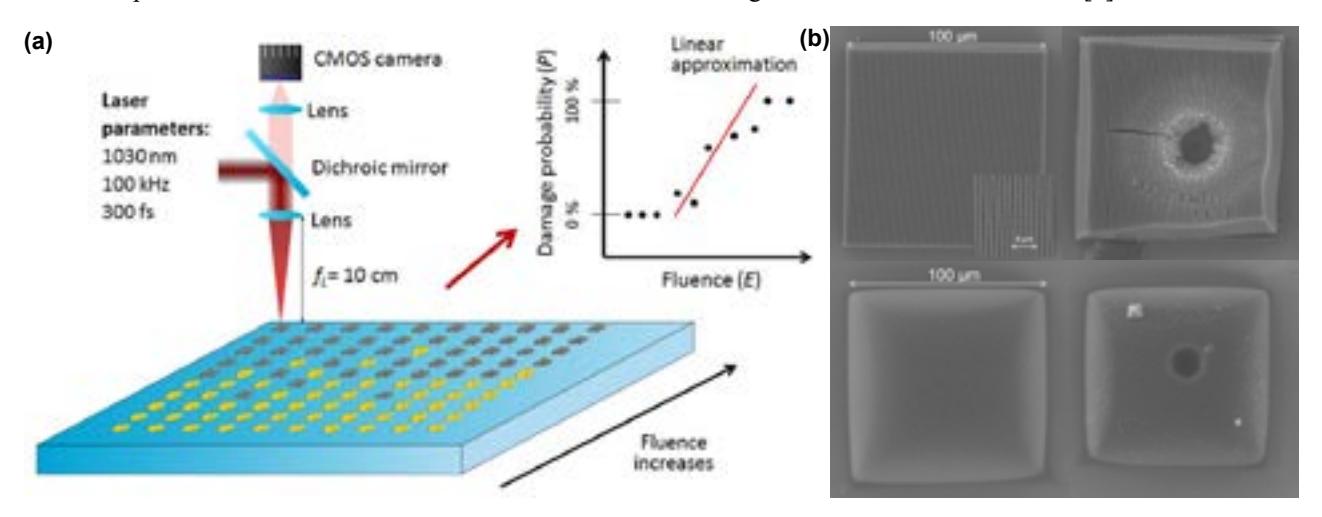
One of the most rapidly developed laser material processing techniques is 3D laser lithography (3DLL) [1]. This technology is based on nonlinear light-material interaction processes. This gives the possibility to make true 3D structures with sub-diffractive resolution. One of the key areas where 3DLL shows huge potential is micro-optics and photonics. In literature we can find lots of examples of functional micro-lenses and photonic crystals made by 3DLL technique [2, 3]. However, before they will become wide spread solution it is important to determine laser induced damage threshold (LIDT) of these elements.
This work is dedicated to 3DLL fabrication and LIDT characterization of polymeric bulk and woodpile structures. Various polymers and components of different internal geometries (bulk and woodpile structures) were investigated according S-on-1 measurement technique [4] as described in ISO standard [5]. The materials tested in bulk configuration were SZ2080, SZ2080 + 1% Irgacure 369 photoinitiator, PEG, SU8, Ember Clear, and Ormo Clear. Also, LIDT experiments of SZ2080 and SZ2080 + 1 % IRG woodpile structures were performed. Moreover, different porosity SZ2080 woodpiles were tested. After experiments it was noticed that the most resilient material for optical components was SZ2080. The same material woodpile structures have smaller LIDT value than the bulk ones. Also, depending on the porosity of mentioned structures, the empirically examined woodpiles acted as photonic crystals with specific photonic properties that influenced the observed LIDT. It implies that LIDT of photonic crystals are caused and determined by several mechanisms. An FDTD model [6] was used to test formed woodpiles functionality. Thus, it is important to compare LIDT of photonic crystals with the same reflection/transmission characteristics in order to get accurate dependency on its porosity. Consequently, we investigated woodpiles LIDT relation with its porosity without changing its functionality, but meaningful dependency was not noticed. After evaluating all the LIDT results SZ2080 without photoinitiator was clearly more superior to any other tested material for both bulks and woodpiles, reaching LIDT of up to 160 mJ/cm2 in bulk, which is around one order of magnitude lower than fused silica [7].