
There is a growing focus on renewable energy sources in the world and one of the most promising is solar energy. Converting it into electricity can theoretically satisfy the energy needs of mankind. Therefore, in many countries, development of technologies utilizing solar energy is stimulated in various ways. Over the last few years, perovskite solar cells (PSCs) have become a subject of great interest in the development of next generation solar cells (SCs) that have already exceeded 22% efficiency [1]. These elements are characterized by simplicity of construction and cheap raw materials compared to common (commercial) silicon SCs. Faster commercialization of the PSCs technology is hindered by drawbacks that need to be resolved. Firstly, hole transporting organic semiconductor spiro-OMeTAD, crystallizes in the device over time, thus reducing its efficiency [2]; secondly, additives are needed to increase the conductivity of semiconductor, which are the cause of rapid device degradation. Therefore, the search for new efficient organic semiconductors remains highly relevant.
In this work a new organic p-type semiconductor with four carbazolyl chromophores (Fig.1), which would be suitable for use in constructing PSCs was synthesized.
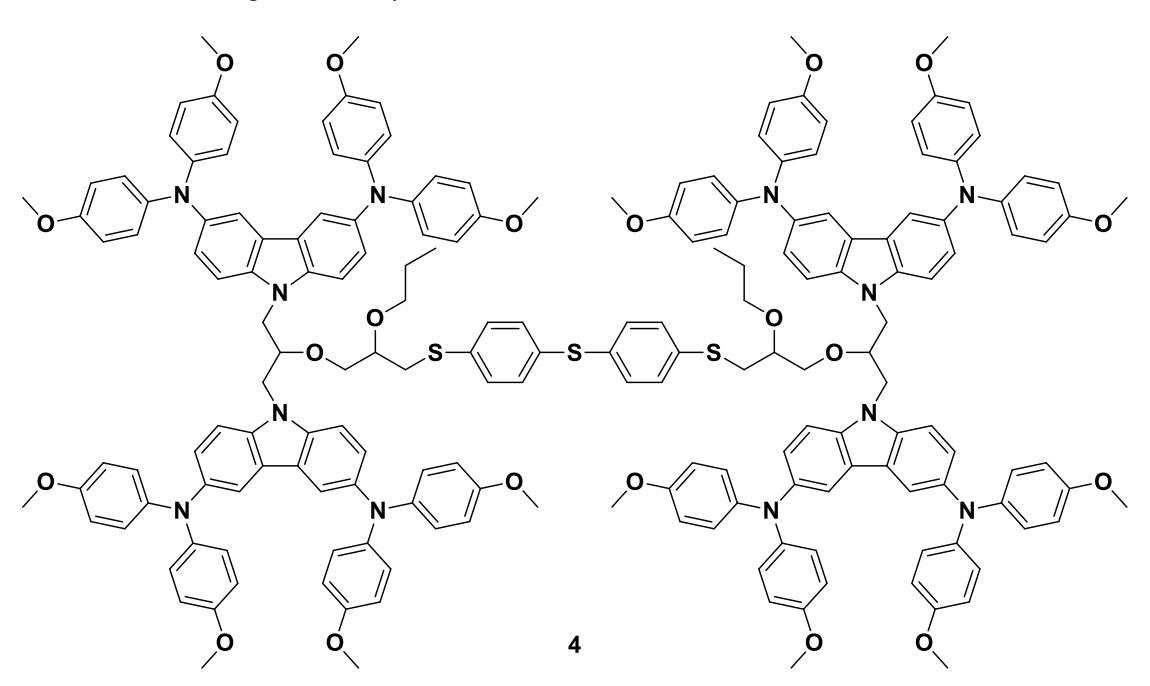
In order to obtain the target product from 3,6-dibromocarbazole, a glycidyl ether reacted with 4,4'-thiobisbenzenethiol and an intermediate tetramer was isolated. Then, during the alkylation, its analogue with alkoxy groups was obtained. The target product from tetramer and 4,4'-dimethoxydiphenylamine wasn't obtained during the Buchwald reaction. The goal product was isolated in an alternative way. The glycidyl ether with four diphenylamine fragments was synthesized and then tetramer was obtained during reaction with 4,4'-thiobisbenzenethiol. The final alkylation step yielded the target compound 4.
The structure of the newly synthesized organic semiconductor was confirmed by 1H NMR, 13C NMR, IR spectroscopy. The thermal, optical, and electrical properties of the compound, which will allow to judge its suitability for PSCs, are currently being investigated.