
Dimethildihydropyrenes (DHP, closed ring form) are one of the most popular photochromic compounds that could be reversibly converted into cyclophanediene (CPD, opened ring form) when exposed to visible light. This kind of photochemical reaction leads to changes in physical properties such as absorption and fluorescence of DHP (Fig. 1). DHP substances could be applied in wide range of areas such as organic electronics, for example single molecule memory elements, and biology – diagnostics, control of metabolic reactions. To achieve even more suitable physical properties for different applications, DHP molecules could be modified by adding substitutes. However, the most common problem of these modified compounds is stability. To solve this problem, there is a need of deeper understanding of processes appearing during photochemical reactions [1].
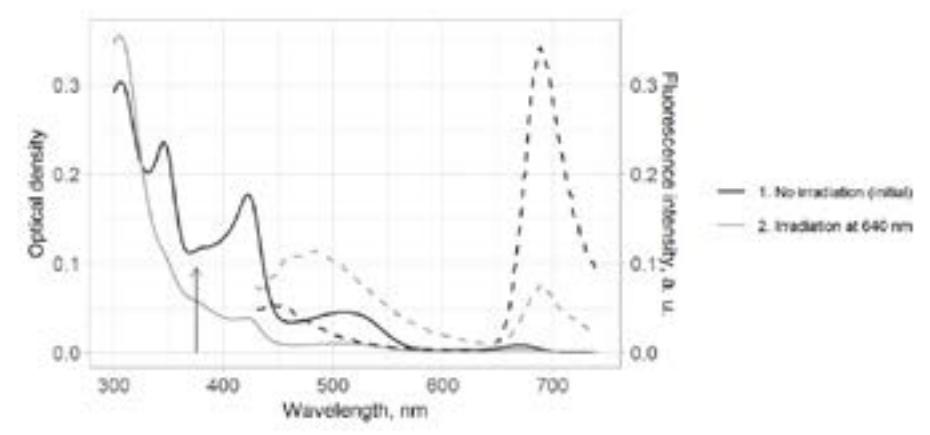
In our study, two derivatives of DHP were synthesized and its physical properties were measured. Several methods such as stationary absorption, transient absorption, fluorescence and fluorescence life time spectrometry techniques were used in sequential way for both DHP and CPD states. Control of photochromic form conversion were performed using additional UV (340 nm) and red light (640 nm) exposition. We found out, that the ring opening could be detected by measuring fluorescence life time (the fluorescence life time of DHP and CPD are respectively >3 ns and 0.2 ns). In addition, transient absorption measurements data gave supplement information about changes in DHP during photochemical reactions.