
All living creatures are exposed to ionizing radiation. Even though they are adapted to low doses, high doses of gamma radiation may predispose organisms to high risks of certain diseases' developing and lethality [1].
The growing dependence on nuclear power obliges us to predict possible harmful results caused by radiation. The adverse effects of acute radiation doses on mammals are fairly understood, however there is still lack of information about their impact on aquatic organisms.
Effects of low (5 Gy) and high (20 and 35 Gy) doses of gamma radiation were examined on the behavioral changes (including mortality, loss of balance etc.) of Carassius gibelio (n=112). Negative effects of gamma radiation on survival were observed as radiation level increased (Fig.1).
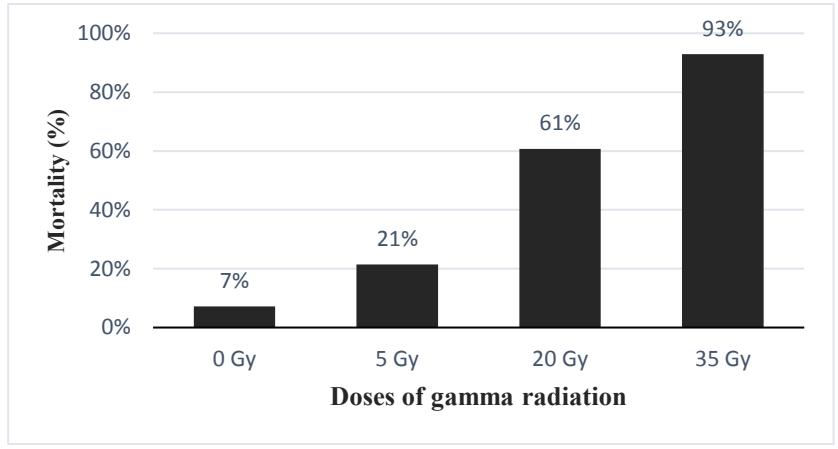
Such symptoms as orientation loss, uncoordinated movements and hemorrhages were registered several hours after irradiation session. Control group demonstrated the lowest mortality rate (P<0,05) at the end of the experiment. Thus, consideration must be given to the level of gamma radiation and its influence on aquatic ecosystems.