Hybrid perovskite frameworks are an emerging family of materials with interesting dielectric, ferroelectric and magnetic properties which could be useful in such applications as charge storage and optoelectronic devices. In general, these materials are composed of metallic centers joined together by organic or inorganic linkers forming a porous framework. Each pore confines a single molecular cation. The majority of such hybrid perovskites exhibit structural phase transitions followed by the cation ordering and framework deformation [1].
A powerful method to study local structural changes and dynamic effects in hybrid perovskites is the electron paramagnetic resonance (EPR) spectroscopy. In this study we employ continuous-wave (CW) X-band (9.37 GHz) EPR to study the structural phase transition of a recently reported [2] [(CH3)2NH2][Cd(N3)3] (DMACd) hybrid perovskite doped with a small amount of paramagnetic Mn2+ ions.
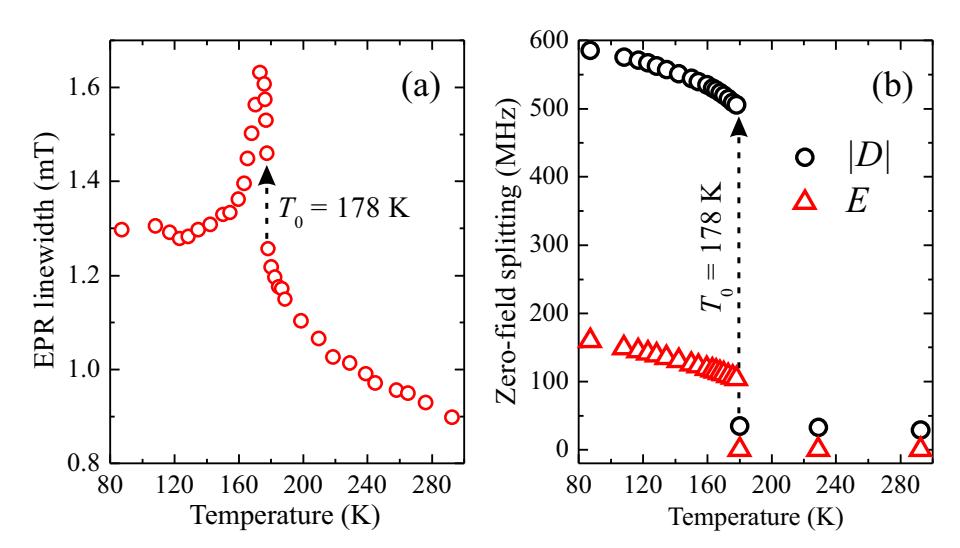
The obtained temperature dependent EPR spectra of DMACd:Mn2+ powder shows typical patterns of Mn2+ ions in the 3d5 electronic configuration, which means that these ions have successfully replaced Cd2+ centers and formed MnN6 octahedra. Upon cooling, CW EPR spectra exhibit a drastic change at the phase transition temperature of 178 K demonstrating that Mn2+ centers are also susceptible to the phase transition. A sudden anomalous increase of the EPR linewidth at 178 K followed by a maximum at 174 K, shown in Figure 1a, indicates a first-order character of the phase transition.
To further characterize Mn2+ centers in DMACd, we performed simulations of the experimental CW EPR spectra using the following spin Hamiltonian [3]:
$$\mathbf{H} = \mathbf{H}_{EZ} + \mathbf{H}_{HF} + \mathbf{H}_{FS},\tag{1}$$where the first and second terms describe the electron Zeeman and hyperfine interactions, respectively. The last term describes the fine-structure of the spectrum which is usually characterised by the axial D and orthorhombic E zero-field splitting parameters. In our case, these two parameters measure the distortion of the MnN6 octahedra which is directly influenced by the DMA+ cation motion. The temperature dependences of D and E parameters, obtained from simulations, of Mn2+ probe ions in DMACd are presented in Figure 1b. A sharp increase of these parameters at 178 K confirms a strong first-order character of the structural phase transition in DMACd.