
The production of ultracold assemblies of alkali metal atoms and diatomic molecules containing such atoms has become a topical and rapidly developing direction in molecular and optical physics. Unlike atoms, molecules have more degrees of freedom, which gives the unique properties and the ability to manipulate them for using in various fields: creation of a Bose-Einstein condensate and subsequent studying of a new type of matter; quantum information processing by capturing such molecules into optical and magnetic traps, testing fundamental laws of physics by precision spectroscopy measurements; in controlled chemical reactions; investigating dynamics of low-energy collisions and etc. [1]. For the applications mentioned one needs to produce such molecules in the absolute ground state. So the knowledge about the ground and low-lying electronic states, spectral and other properties of ultracold diatomic molecules are crucial for potential use, which can be obtained by series of experiments or by performing ab initio quantum-chemical calculations and applying appropriate molecular theories. The diatomic polar KCs molecule is a typical example of ultracold molecules under comprehensive study.
The main goals of this study are prediction of the ground state potential energy curve (PEC) of the KCs molecule within spectroscopic accuracy (i) and calculation of the transport properties (coefficients of diffusion, viscosity, thermal conductivity) of the rarefied potassium and cesium gas media on the basis of calculated PEC (ii).
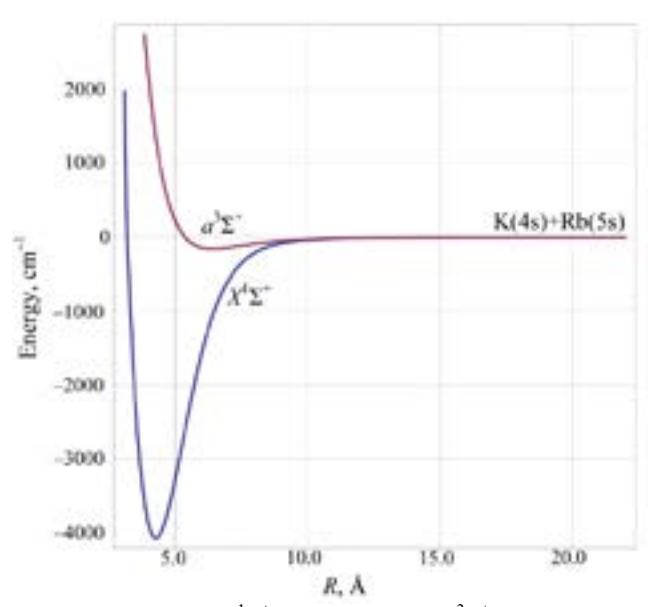
In this study, the SA-CASSCF(6,8)/XMCQDPT2 [2] calculations of the ground X1Σ+ and first triplet a3Σ+ states of the KCs molecule are performed (Fig. 1). The TZ-basis sets and Stuttgart RSC ECPs have been used in calculations. The results of our calculations of the spectroscopic parameters of the KCs's ground state X1Σ+ (Re = 4.2781 Å, De= 4070.3 cm-1) very well coincide with experimental data (Re = 4.2838 Å, De= 4069.2 cm-1 [3]). This is the best agreement among all previously performed for KCs molecule ab initio calculations.
On the basis of the kinetic theory of gases [4] the transport properties of a rarefied two-component K-Cs gas were calculated. These properties are uniquely related to the reduced collision integrals, which were obtained by calculating the distance of the closest approach of the particles involved in the collision, the angle of deflection and the collisional cross-section. Since the integration is carried out in the region of positive values of the potential, thus an extrapolation by the corresponding function into the region of small internuclear distances was carried out. The obtained coefficients depending on temperature and pressure are being planned to compare with experimental values.