
The interest in the formation of ultra-short laser micro/nano machining of self-organizing surface structures has grown significantly in the last decade, due to its promising applications in various fields. Textured materials, that undergo femtosecond laser treatment, have shown to possess altered mechanical, chemical, tribological, and wetting properties [1, 2, 3].
Periodic structures of the nano scale, also known as ripple, were selected for the study. Laser-induced periodic surface structures, further LIPSS, were first investigated in 1965 [5]. Observed LIPSS nano structures exhibit a surface geometry of long periodic grooves and bumps. The low spatial frequency LIPSS periodicity is close to the central frequency of the laser radiation if the beam used is perpendicular to the sample's surface, and the orientation of the structures is perpendicular to the incident laser radiation electric field direction. The mechanism that drives the formation of low spatial frequency structures is generally accepted to be due the interference between incident laser beam and scattered optical surface waves [6].
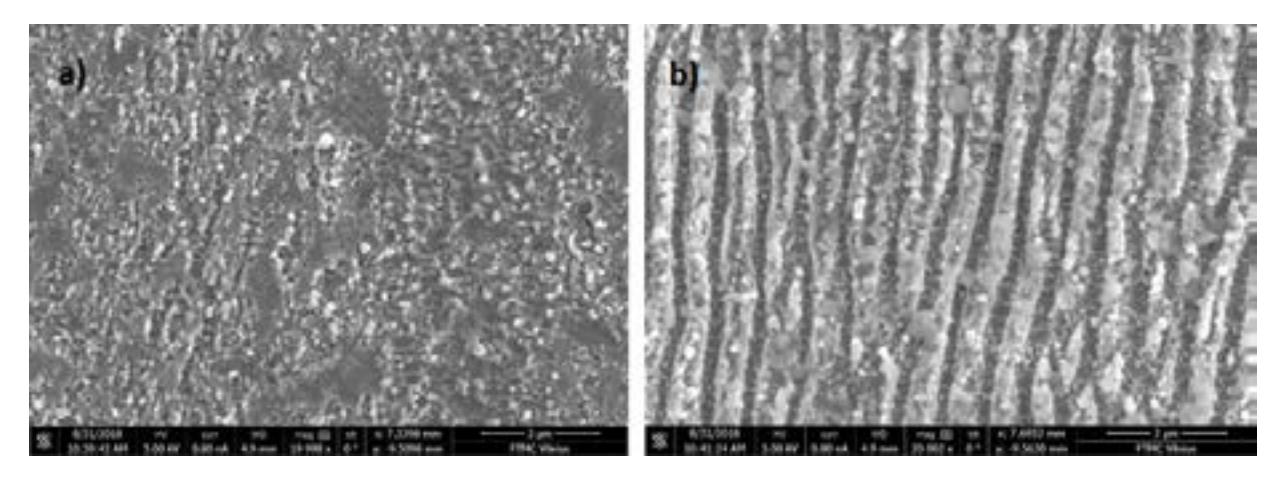
In this study self-reorganizing surface structures on Titanium Ti-6Al-4V sample and its dependence on laser parameters was observed, exclusively focusing on ripple morphology induced changes in drag reduction of the material. As shown in figure 1. periodicity and other characteristics of LIPSS can be altered by variation of irradiation parameters [7]. In fig. 1 a) a chaotic morphological structure is observed, whereas in fig. 1 b) a non-random ripple structure appears.