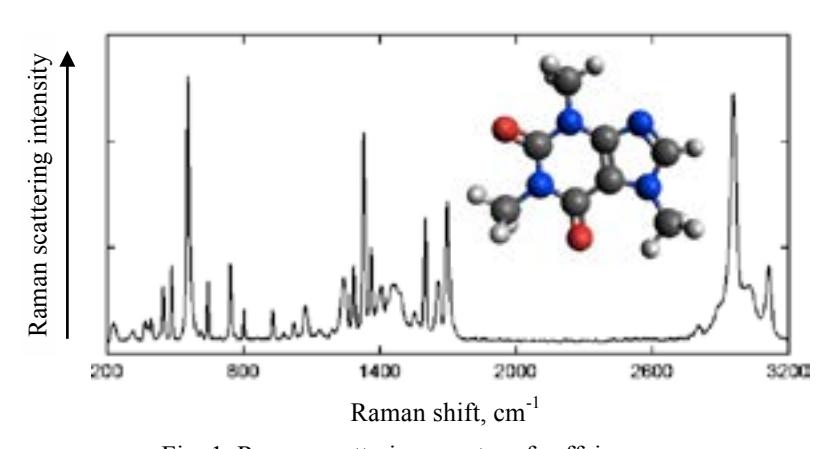
Detecting addictive and potentially dangerous psychoactive substances in the human body is an important area of medical research. Chemical compounds, most often of plant origin and belonging to the group of psychoactive substances, are called alkaloids. This group includes caffeine which is widely used and easily available worldwide. It is used in small amounts as a central nervous system stimulant that inhibits sleepiness and improves reaction, concentration and coordination. However, high doses of caffeine can cause serious health disorders, and in case of people with health problems, caffeine overdose can even lead to death [1-2]. This is especially important nowadays, as manufacturers often hide or misrepresent the true composition of the product.
The aim of this work is to identify and improve a sensitive and accurate methodology for detecting caffeine and other alkaloids in the human body by studying human biological fluids, and more specifically, saliva. The main advantage of saliva is that no special extraction devices and preparation methods are required. During the study, the main goal is to determine the minimum caffeine concentration (< 1 mM) that can be detected by Raman scattering spectroscopy methods (Fig. 1). To achieve this goal, a non-destructive electrochemical surface enhanced Raman scattering (E-SERS) spectroscopy method was used. As electrochemical processes can accurately control the strengthening of the SERS signal, the areas of use of E-SERS in medicine are expanding rapidly [3].
In order to strengthen the Raman scattering signal of the studied molecule, solutions of several noble metals (Ag and Au) nanoparticles, different ways of forming nanoparticle layers on the electrode surface and different electrode electric potential values are used. Nanoparticles of various sizes and shapes are prepared using steric (polymers) and electric (citrate molecules) stabilization. The dependence of enhancement factor on nanoparticle concentration is also investigated. The concentration is changed by centrifuging the colloidal solutions. The most effective method is used to investigate model saliva and caffeine solutions. Creating the optimum methodology will allow us to detect relatively quickly not only the amount of caffeine in the body, but also to identify the potentially toxic narcotic alkaloids contained in the human body.