Metal-free organic materials that show room-temperature phosphorescence (RTP) are attractive alternatives to organometallic phosphors because of their low cost, abundant and environmentally friendly properties, flexible synthesis, and good stability. In particular, metal-free organic molecules showing efficient RTP have great potential in diverse optoelectronic and photonic applications, such as luminescent labels, imaging and sensing, and even organic light-emitting diodes [1].
Here we report on a series of metal- and halogen-free molecules based on thianthrene and phenothiazine units. Photophysical properties of thianthrene derivatives have not been extensively studied so far while phenothiazine is a unit in many luminescent materials [2] and emits phosphorescence at room temperature in solid Zeonex® films. By varying the number of phenothiazine units, it was intended to study the impact of these substituents on the emissive and photoelectrical properties of the synthesized compounds.
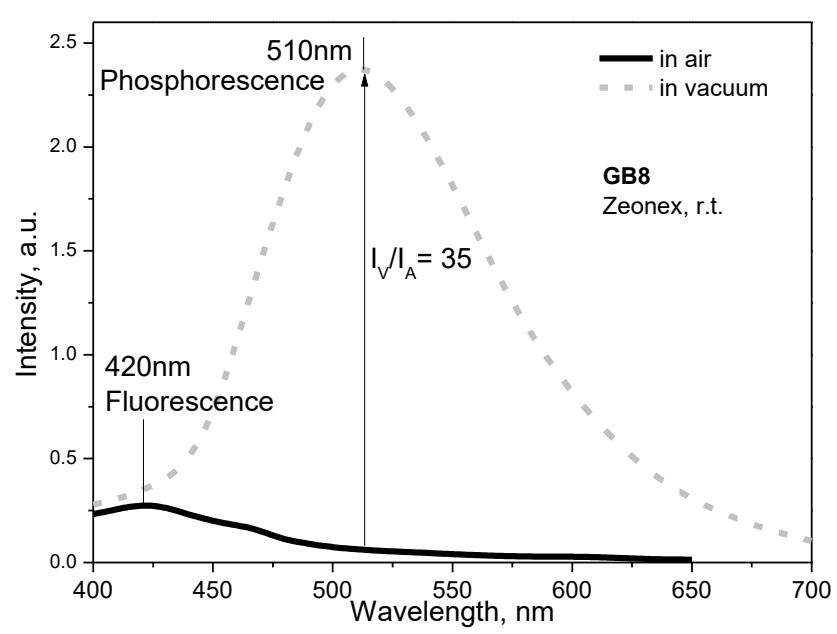
Emission spectra of the solutions of all the studied compounds in low-polarity toluene were found to be of structureless shape. While in solutions phosphorescence is completely quenched by oxygen and collision between solvent and solute molecules, in the solid state these quenching factors are omitted, thus promotion of intersystem crossing rate ($k_{ISC}$) can occur. Upon degassing the solid samples of molecular dispersions of the compounds in Zeonex®, emissive bands peaking at 510 nm showed up (Fig. 1). In case of solution of GB8 compound the contribution of phosphorescence was found to be high at room temperature. The ratio of integrated areas of photoluminescence (PL) spectra of the solution of GB8 compound acquired with and without oxygen reached 35.
To give insight into electron properties of studied molecules the cyclic voltammetry, photoelectron spectroscopy and charge transporting properties have been performed.