FIRST EARTH-SCALE QUANTUM SENSOR NETWORK: DARK MATTER SEARCHES WITH THE USE OF OPTICAL ATOMIC CLOCKS
Beata Zjawin1, Piotr Ablewski1, Kyle Beloy2, Sławomir Bilicki1, 3, Marcin Bober1, Roger Brown2, Roman Ciuryło1, Robert Fasano2, Hidekazu Hachisu4, Tetsuya Ido4, Jerome Lodewyck3, Andrew Ludlow2, William McGrew2, Piotr Morzyński1, 4, Daniele Nicolodi2, Marco Schioppo2, Mamoru Sekido4, Rodolphe Le Targat3, Piotr Wcisło1, Peter Wolf3, Xibo Zhang2, Michał Zawada1
1 Institute of Physics, Faculty of Physics, Astronomy and Informatics, Nicolaus Copernicus University, Grudziadzka 5, 87-100 Torun, Poland
2 National Institute of Standards and Technology, 325 Broadway, Boulder, CO 80305, USA
3 SYRTE, Observatoire de Paris, PSL Research University, CNRS, Sorbonne Universités, UPMC Univ. Paris 06, LNE, 61 avenue de l'Observatoire, 75014 Paris, France
4 National Institute of Information and Communications Technology 4-2-1 Nukuikitamachi, Koganei, 184-8795 Tokyo, Japan
Observations at astronomical scales provide a strong evidence for the existence of dark matter. It is responsible for the structures that we see in the Universe, however we do not know what it consists of. We can only observe the gravitational interactions of our matter with dark matter, for example the impact that it have on stars and galaxies. Examining dark matter structure requires fine models that explain its composition in both macro and micro scales. Searches for dark matter in form of topological defects or oscillating massive scalar fields must be executed in the best laboratories in the world that enable examining the fundamentals of physics.
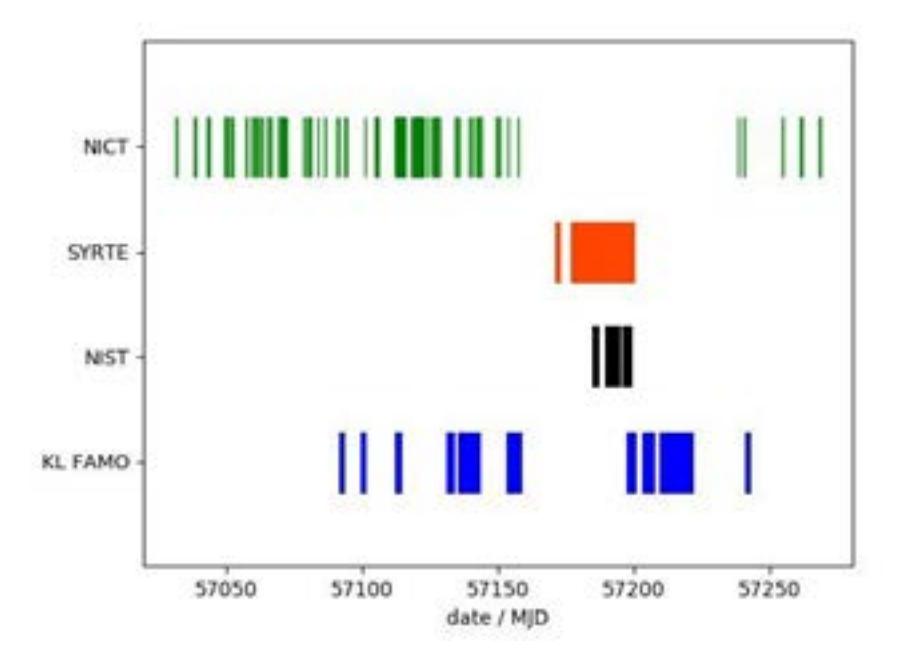
We established the first Earth-scale quantum sensor network based on optical atomic clocks [1]. It is aimed at dark matter detection. We provide a new bounds on dark matter-standard model coupling for the cases of both topological-defect dark matter and oscillating massive scalar fields. We use the archival data (see Fig. 1) to constrain existing dark matter models. With the use of Yb and Sr optical atomic clocks placed at three continents to improve the previous results by two orders of magnitude.
Fig. 1. Data availability from four operating optical atomic clocks: National Institute of Information and Communications Technology (NICT) in Tokyo, Observatoire de Paris (SYRTE) in Paris, National Institute of Standards and Technology (NIST) in Boulder and National Laboratory of Atomic, Molecular and Optical Physics (KL FAMO) in Toruń.