
Upon irradiation of a semiconductor with high energy particles, a number of processes take place in the material, including generation of vast number of non-equilibrium carriers. These carriers alter material optical and electrical properties even on very short timescales; therefore, this process can be important in a number of applications, particularly in radiation detectors operating under strong irradiation [1]. Therefore, there is a demand for fast and sensitive ways to observe the dynamics of free carriers in semiconductors and scintillating materials that can be used in devices operating under irradiation. One of the parameters characterizing the optical response of a material to free carriers is the cross-section of free carrier absorption $\sigma_{FCA}$.
In this presentation, we demonstrate the determination of free carrier absorption cross-section in radiation hard materials GaN, SiC, and GAGG:Ce. For the measurements, we used a pump-probe technique based on YAG:Nd laser emitting 25 ps duration pulses. The nonequilibrium carriers were photoexcited using pulses at 355 nm and probed by the pulses at 1064 nm, which were delivered to the sample via 5 m fiber. The density of the excess carriers was varied within the $10^{18}-10^{20}$ cm-3 range by using the optical attenuator.
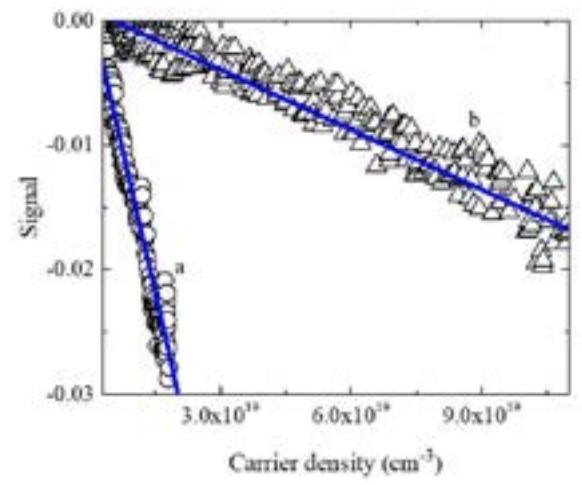
Figure 1 shows the dependence of differential transmission signal on photoexcited carrier density in the investigated samples. The cross-section of free carrier absorption $\sigma_{FCA}$ is a material-specific parameter strongly depending on the wavelength. We determined the $\sigma_{FCA}$ values at 1064 nm in the investigated materials by fitting the data in Figure 1; the values are presented in Table 1.
| GaN | SiC | GAGG:Ce |
|---|---|---|
| $3 \cdot 10^{-17} \text{ cm}^2$ | 1.4·10-17 cm2 | $5.2 \cdot 10^{-18} \text{ cm}^2$ |
The other important parameters influencing the amount of free carrier absorption include the free carrier lifetime and the availability of thick crystals. Carrier lifetimes were determined from the pump-probe signal transients and varied from 2 ns for SiC to 79 ns for GAGG:Ce. Taking into account these factors, we conclude that thick GAGG crystals may be advantageous if high free carrier absorption coefficient is required.